
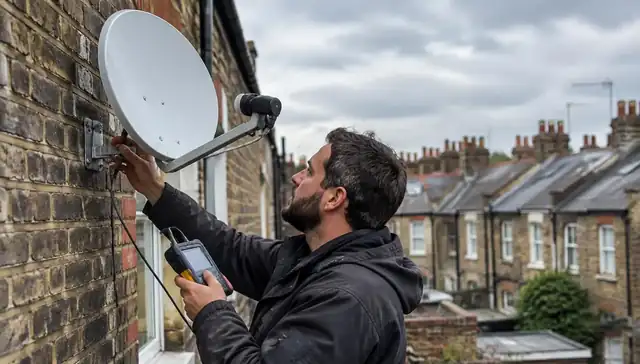
Across EN1 and EN2, the practical work varies between a short run into an Enfield Town terrace and a longer route through a larger Chase Side house. We look at the whole connection, including the cable already hidden behind your television, rather than assuming a new dish will solve everything.
Choose the receiving system before the bracket
Tell us the make and model of your satellite box, not just the provider name. Older Sky equipment, Sky Q and different Freesat receivers can require different outputs from the LNB, the small receiving unit held in front of the dish. A matching connector alone does not establish compatibility.
We work as independent installers, so subscription changes remain with your provider. Our job is to provide the appropriate dish, feeds and connections for the agreed receiver. If you intend to keep another box upstairs, mention it now: supporting two receiver types may change the LNB specification and cable plan.
The satellite path matters more than roof height
The usual UK Sky and Freesat services come from the satellite position at 28.2 degrees east. We assess the actual path towards it, including neighbouring roofs and trees. Enfield's distance from the Crystal Palace television transmitter does not determine satellite reception; these are different receiving systems with different requirements.
Near Forty Hall or on a tree-lined EN2 plot, a high mounting point is not automatically the best answer. We compare accessible positions and look for an unobstructed path with dependable support. A lower wall can be suitable if the view is clear. We explain any obstruction before you agree to installation.
Coverage across the borough →Nearby Winchmore Hill installations →
Longer houses need a deliberate cable route
A rear living room, side extension and upstairs bedroom can create quite different cable distances in a Chase Side semi. We walk the route with you, identify the receiver inputs and decide where the cable should enter. Existing holes are useful only when their position and condition suit the new work.
We use suitable screened satellite coax, clip exterior runs securely and protect connectors against moisture. Inside, we avoid tight bends and crushed sections under windows or carpets. Any reused cable is tested rather than trusted because it looks tidy. We agree visible runs before drilling and seal the finished entry against weather.
Do not align a dish on an unstable support
If channels disappear in gusts, we examine the bracket and its fixing surface before adjusting the reflector. Loose bolts, rusted components or deteriorating masonry can let a dish move just enough to spoil reception. We assess safe access and specify a sound mounting rather than repeatedly correcting the same movement.
For a repair, we distinguish structural trouble from failed electronics or damaged coax. We can retain a serviceable dish while replacing the faulty part. After the support is secure, we set direction, elevation and LNB rotation using measured reception quality. A rough compass bearing is only a starting point, not a completed alignment.
Reception fault investigation →Satellite help in Palmers Green →
Extensions and scaffolding can interrupt a working setup
Roofing work around Enfield Chase may temporarily obstruct a dish or require it to move. Contact us before scaffolding encloses the existing position where possible. We can consider a suitable alternative, cable length and the sequence of work, rather than discovering that the television has stopped after the scaffold is erected.
An extension may also turn a previously clear signal path into a permanent obstruction. We inspect the proposed finished roofline, not just today's open space. Any temporary arrangement needs safe fixings and access too. Once building work ends, we check the final position and remove redundant agreed cabling without disturbing other services.
Flats need permission and a distribution check
In an Enfield Town flat, a satellite socket may connect to equipment owned by the building. We establish that before proposing a private dish. Ask the managing agent about the shared system and access arrangements; tell us whether other residents are affected if reception has failed.
A communal feed does not necessarily support every receiver in its present form. We inspect the available distribution arrangement and identify what a proposed upgrade requires. We will not alter shared equipment without authorisation. Lease conditions, planning restrictions and any listed status also need checking before a new external mounting goes ahead.
Communal receiving systems →Dish positioning and restrictions →
Handover means checking the receiver indoors
We test suitable satellite transponders and the feeds your box actually needs. Indoors, we confirm the signal reaches the intended inputs, demonstrate live reception and check supported recording functions. Finding one working programme is not enough to show that all the necessary paths are healthy.
We explain any site limitation, including obstruction or an existing cable you have chosen not to replace. Extreme weather can still interrupt satellite reception, but ordinary showers should not be excused without checking alignment and water ingress. You leave the visit knowing which components changed and how the finished arrangement connects together.
Arrange an EN1 or EN2 visit
Call free on 0800 206 2385 or send a WhatsApp message to 07595 292534. Include your postcode, box model and any ground-level dish photograph you can safely take. Tell us about parking restrictions, locked side access or building work so we can plan the visit sensibly.
We are Finchley Aerials and Satellites, Britannia Road, Finchley N12 9RU, bringing 25 years' experience. Free advice is available Mon-Sat, 8am-7pm; outdoor appointments continue until sunset where conditions allow. We offer same-day attendance where possible and provide a fixed written quote before you authorise the agreed work.