
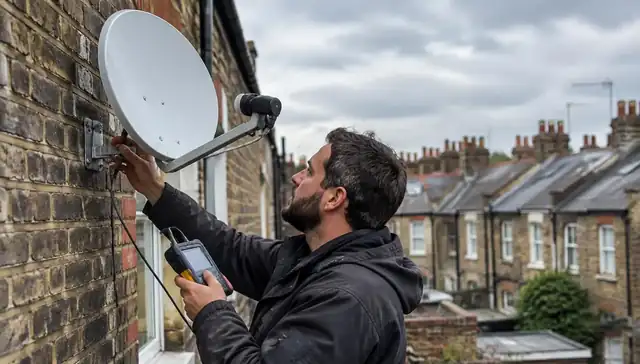
A dish can look straight and still lose channels. A cable can fit the socket and still belong to the wrong setup. We check the receiver, dish, LNB and cable together before recommending work. We install independent Sky, Sky Q and Freesat systems across Finchley and North London.
We bring 25 years' experience to awkward dish positions, tired fixings and cable routes through London homes. Call free on 0800 206 2385, Mon–Sat 8am–7pm. We offer same-day service where possible. You get a fixed written quote before work starts, with the mounting position and cable route agreed.
Independent help with Sky, Sky Q and Freesat
We work independently of Sky. We install and repair the receiving equipment; your subscription and account remain with your provider. Tell us the exact box model when booking. Sky Q, older Sky receivers and different Freesat generations have different LNB requirements. We check compatibility before changing anything on the dish.
The LNB is the receiving unit on the dish arm. Some installations need a wideband LNB, others a universal type, and mixed systems need a compatible arrangement. We check the receiver specification and number of feeds. We also identify spare or abandoned cables so the finished setup is understandable.
A clear view of the satellite comes first
Sky and Freesat reception generally uses the satellites at 28.2° east. The dish needs a clear path in that direction. We assess walls, trees, neighbouring buildings and proposed extensions before choosing a position. Moving the dish higher only helps when that move actually clears the obstruction and leaves a sound fixing point.
Consider a typical Highgate extension job: a new roof crosses the dish's signal path. We survey an alternative position, check the cable distance and agree the visible route before moving it. That sequence keeps the work focused. Turning the old dish towards a different gap does not change where the satellite sits.
Dish moves, realignments and repairs
Scaffolding, roofing work and garden growth all change a previously working installation. We check alignment with a meter, inspect the bracket and test the LNB and cable. If the dish and support are serviceable, we keep them. A failed connector or displaced dish does not justify replacing the entire system.
When a dish moves in the wind, we inspect its fixings before realigning it. Loose masonry, corroded bolts and a flexing bracket will undo careful alignment. We secure the agreed mounting, set azimuth, elevation and LNB skew, then measure reception quality. We check the receiver indoors as part of the same job.
Discreet mounting in Hampstead, Highgate and the Suburb
A front-facing dish can be the wrong answer on a protected street. In Hampstead, Highgate and Hampstead Garden Suburb, we look for discreet positions with a usable satellite view. Rear walls and lower mounting points are options we test on site. Hiding a dish behind solid brick blocks its signal too.
We check the proposed position against the permissions that apply. Conservation area rules restrict some dish locations, including certain positions facing a highway. Listed buildings, leasehold terms and Hampstead Garden Suburb Trust requirements add separate checks. We ask you to secure the required approval before installation. A small dish still needs the right permission.
Tidy cable runs through real London buildings
We agree the cable route before drilling. On Victorian terraces in N12 and N2, we look at side returns, existing service routes and the room where the receiver sits. We use WF100 screened coax for suitable new satellite runs, secure it neatly and protect external connections against water entry.
At the wall, we plan a weatherproof entry and seal the penetration around the cable. Indoors, we avoid trailing loops and identify the feeds. We test existing coax before reusing it. A fresh dish on the wall will still disappoint if the cable beneath the window has been crushed during building work.
Mansion blocks and shared satellite feeds
In mansion blocks around NW11 and N6, the dish on the roof often belongs to the building's communal system. We establish ownership before touching it. Tell us whether neighbours have lost reception and whether the managing agent controls the equipment cupboard. We need authorised access to work on shared infrastructure.
A Sky Q upgrade in a flat needs a compatibility check at the communal system as well as the receiver. We inspect the available feed and distribution arrangement, then explain the work required. We keep private alterations separate from shared-system work so your installation does not disrupt another resident's television.
We test more than one working channel
A single channel proves very little about a satellite installation. We measure quality across suitable transponders and confirm the feeds needed by your receiver. We check live viewing and the recording functions available on your box. We also inspect the outside connections and confirm that the cable is properly supported.
Heavy rain puts extra pressure on a marginal signal. We align for a dependable reception margin and explain any site limitation before you commit. We cannot remove extreme weather from satellite reception. We can address poor alignment, tired fixings and damaged cable that make ordinary rain a regular viewing problem.
Book a satellite visit with us
We cover Finchley, Muswell Hill, Hampstead, Highgate, Golders Green, Hendon and Colindale. Send your postcode, receiver model and a ground-level photo of the existing dish if you have one. Tell us about scaffolding, planned building work and access restrictions. Those details help us arrive prepared for the installation.
Call free on 0800 206 2385, Mon–Sat 8am–7pm. We offer same-day service where possible and confirm safe access before roof work. We explain what stays, what changes and what the job costs in a fixed written quote. At handover, we walk you through the installation and the applicable guarantee.