
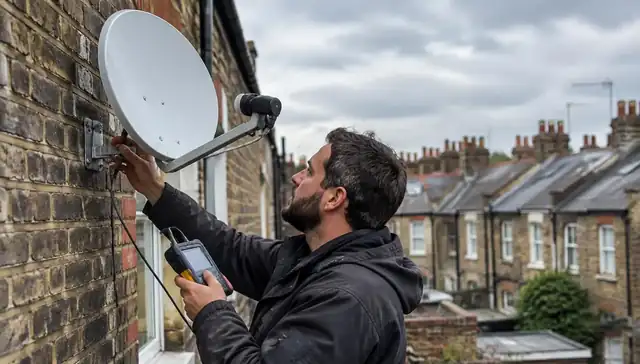
NW4 includes inter-war semis, terraces and flats around Brent Street and Hendon Central. Those buildings call for different cable routes and access arrangements. We establish the practical details first, then explain the work and its cost without assuming that replacing everything is the easiest answer.
Start at the box, not the shopping basket
Give us the receiver model before ordering parts. Older Sky equipment, Sky Q and different Freesat models do not all use the same LNB outputs. We inspect the receiving unit on the dish and count the feeds available indoors. That avoids fitting a new box to a connection it cannot use.
Recording features can depend on the number and type of feeds as well as the receiver itself. We discuss what you expect to watch and record simultaneously, then choose a compatible arrangement. We provide independent installation support, not subscriptions or changes to Sky accounts, and we make that distinction clear when planning the work.
Satellite installation explained →Discuss a receiver change →
Brent Street flats: find out whose feed it is
A wall plate marked satellite may connect to communal equipment rather than a private dish. Before working on a flat near Brent Street, we ask about the managing agent, equipment cupboard and any similar fault in neighbouring homes. A problem confined to one room calls for different checks from a building-wide outage.
We can test the private lead and outlet while keeping shared infrastructure separate. If the receiver needs a different communal arrangement, we explain the compatibility issue and seek authorised access. We will not disconnect another resident to create a spare feed, or attach equipment to a shared facade without the necessary agreement.
A clear satellite path matters more than roof height
UK Sky and Freesat normally receive from the satellite position at 28.2 degrees east. We assess that specific path from the proposed mounting, checking buildings and trees rather than simply looking for open sky. A higher bracket is useful only if it clears the obstruction and has a secure fixing point.
Around Sunny Hill Park, a leafy outlook can disguise a blocked reception angle. On a semi, a side wall may offer a serviceable position without taking cables over the roof. We compare the options on site and explain any access equipment needed before committing to an installation that will be difficult to maintain.
Treat satellite faults as satellite faults
Hendon's A41 and M1 corridor can raise questions about mobile interference affecting terrestrial television. That does not make a Freeview filter a remedy for a missing satellite picture. We identify which service and input have failed, then test the relevant equipment rather than applying an aerial diagnosis to a dish system.
Satellite checks include the LNB supply, cable continuity, connectors and measured reception quality. A failed input or damaged patch lead can leave the dish itself entirely serviceable. Tell us whether all channels disappear, only some services fail, or the trouble follows rain; each detail helps us choose a sensible testing sequence.
Weather-related breakup needs a physical inspection
If wind changes the picture, we check the bracket and masonry before adjusting the dish. Alignment cannot remain stable on a moving support. Rusted hardware, a distorted reflector and loose fixings each require a different response; we show you why a repair is needed instead of relying on the symptom alone.
Rain can expose a weak signal margin or reach a poorly protected connector. We look for water tracking through old coax, renew defective sections where necessary and protect the repaired connection. Afterwards we peak reception using a satellite meter. Extreme downpours can still interrupt a properly installed system, which is different from losing reception in ordinary showers.
Routes that work in lived-in homes
In an inter-war house, the shortest outdoor route may enter the wrong room. We agree the receiver position and the visible cable path together, considering extensions, patio doors and decorated walls. Existing coax is reused only after testing; keeping an unreliable hidden section would undermine the rest of the installation.
New satellite cable is appropriately screened, supported and terminated, with external entries sealed against weather. We avoid tight bends, crushed runs and loose loops where people walk. For rented homes, please obtain approval for drilling or exterior fittings. We discuss trunking and surface routes before starting rather than making decorative decisions on your behalf.
Hendon property information →Satellite service in Colindale →
Check viewing and recording before packing away
At completion we measure the finished feeds and check a selection of channels on your receiver. Where the box supports recording, we verify the available functions instead of treating one live picture as the whole test. We label or explain the connections so reconnecting after cleaning does not become a guessing exercise.
We also distinguish satellite reception from internet-based menus and apps. A dish repair cannot restore an expired viewing entitlement or fix every broadband problem. You get a plain explanation of what has been tested, which components remain in use and any limitation that requires action by a provider or building manager.
Book an NW4 visit without climbing up for photographs
Call free on 0800 206 2385, or WhatsApp 07595 292534 with the postcode and a photo of your receiver label. A ground-level view of the dish is enough for an initial discussion. Tell us about entry codes, shared access or scaffolding, particularly around busier Hendon Central streets.
Finchley Aerials and Satellites is based at Britannia Road, Finchley N12 9RU. We have 25 years' experience, give free advice and answer Mon-Sat between 8am and 7pm. On-site work runs until sunset when safe. Same-day appointments depend on availability; all proposed work comes with a clear price before work starts.