
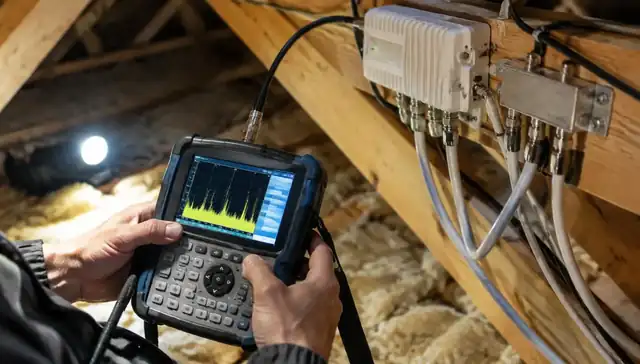
We investigate reception across NW4, from inter-war semis near Sunny Hill Park to terraces and flats around Brent Street. Our job is to explain where the fault sits, what evidence supports that conclusion and what repair is worth doing. We do not begin with a shopping list of replacement equipment.
Interference around the road corridor needs proof
Homes near the A41 and M1 corridor can experience mobile-band interference, but proximity alone proves nothing about your installation. We examine the spectrum and compare the wanted television signals with unwanted energy. The important question is whether an amplifier or receiver is being overloaded, and at which point.
If a filter is indicated, we test its effect ahead of the affected component. Putting it after an overloaded amplifier may leave the damage to the wanted signal unresolved. We also check cable screening and connectors, because interference entering a poorly screened indoor lead requires a different remedy from interference entering at the aerial.
Is it the whole building or just your lounge?
In a flat near Hendon Central, we first establish whether the television uses a private aerial or a shared feed. Ask neighbours whether their reception has changed, without disconnecting anything in a communal cupboard. One working neighbouring set is useful information, although different branches can still have different faults.
We test your accessible outlet and receiver lead, then agree how to reach shared equipment if needed. A managing agent may need to arrange keys, permissions and a suitable time. We clearly separate what has been measured inside the flat from what remains to be checked in the building distribution.
Build a useful fault report before the visit
Tell us whether you lose pictures, sound or the entire channel list. Record a few channel names, the time of failure and whether another room is affected. Include changes such as a new television, furniture moved across a lead or a power socket switched off during decorating.
Do not climb up to inspect the aerial or open powered distribution boxes. A photograph of the television message and accessible equipment labels is enough to begin the conversation. Keep repeated retuning to a minimum: searching during a reception failure may leave you with fewer stored programmes and an extra setup task.
Measure the route from input to outlet
We compare signal level, modulation error ratio and bit error rate across the received multiplexes. Level tells us how much signal is present; the quality measurements help reveal whether the data is usable. We explain why a television can report high strength while its picture remains unwatchable.
In an inter-war semi, a loft splitter may supply several floors through cables installed at different times. We compare its input with each agreed branch and then the room sockets. Where readings deteriorate after one connection, we concentrate there rather than assuming every length of cable in the house needs renewal.
Power and gain can mislead the diagnosis
Some aerial systems rely on a separate supply feeding power along the coax. Unplugging that supply can affect every television, even when the aerial itself is intact. We identify the arrangement, check the supply and inspect accessible terminations before suggesting replacement roof equipment.
More amplification is not automatically better. Hendon generally has useful reception, so excessive gain can create trouble rather than cure it. We evaluate the incoming quality and the losses through the distribution. Any gain adjustment is followed by checks at the relevant outlets, including the weaker broadcast groups.
When rain or movement changes the result
An external cable that looks tidy from ground level can still have split insulation or a vulnerable joint. If reception fails during rain, we inspect accessible outdoor components and compare the available signal margin. We do not describe a connection as water-damaged unless the inspection or testing supports that finding.
For properties towards the RAF Museum, as elsewhere in NW4, roof access depends on the building rather than the postcode. Extensions, shared paths and locked gates need discussing beforehand. A dry-weather visit can still uncover deterioration, but an absent intermittent fault may require observations and a clearly agreed follow-up plan.
Approve the repair after hearing the findings
We tell you what failed, what remained sound and which checks confirm the proposed remedy. You receive a fixed written quote before repair work proceeds. Once authorised work is complete, we revisit the affected measurements and show the agreed televisions receiving their channels. Satellite faults are tested with equipment appropriate to the receiver and feed.
Finchley Aerials and Satellites has 25 years' experience and is based at Britannia Road, Finchley N12 9RU. Call free on 0800 206 2385 or WhatsApp 07595 292534 for advice. Booking hours are Mon-Sat, 8am-7pm; we aim for same-day help when available and carry out on-site work until sunset.