
Much of NW11 receives well, but roofs towards the Hampstead Heath Extension can have more restricted reception. Arts & Crafts houses, inter-war semis and mansion flats also have very different distribution arrangements. We take those details into account without assuming that a local signal shadow explains every frozen screen.
First separate a room fault from a building fault
Before booking, check whether another television has the same problem, if you can do so without moving heavy furniture. Note the programmes affected rather than just saying the picture is bad. We use that information to decide whether to begin at an individual outlet or the common incoming feed.
In mansion flats around Golders Green Road, a shared aerial may serve many homes. Let us know about matching complaints from other residents, but do not open distribution cupboards. We establish permission and access with the responsible person before working beyond your own flat's connections.
NW11 communal installations →Golders Green area information →
Checking the margin near the Heath Extension
A home close to the Heath Extension may receive less usable signal than another property further along the road. We examine the aerial position and measure the broadcast groups, considering nearby roofs and vegetation. The useful question is whether reception has sufficient quality margin, not whether the aerial looks large enough.
We assess Crystal Palace reception from the property itself. If another receiving position might help, we compare practical options and explain the implications for mounting and cable routing. More height or a higher-gain aerial is a possible response to measured conditions, never an automatic prescription for every house near the trees.
Transmitter and terrain guidance →Aerial repairs in Golders Green →
Read the data behind the picture
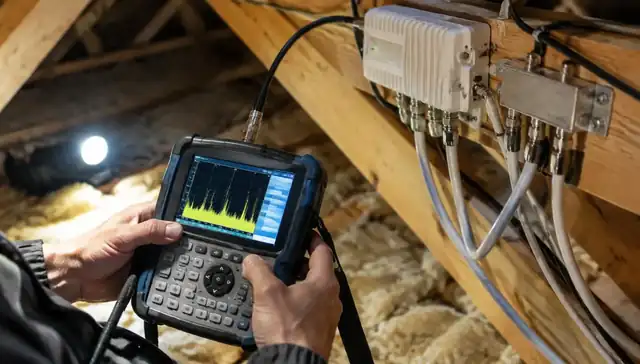
Our diagnostic equipment examines modulation error ratio and bit error rate alongside received level. In plain terms, we are checking the cleanliness of the broadcast data and the errors affecting it. A television reporting high strength may still be struggling with interference, distortion or an amplifier driven beyond its useful range.
We compare frequencies rather than testing one channel and declaring the system healthy. A problem confined to one multiplex can take several programmes away together. Measurements before and after a splitter or amplifier help us establish whether it is introducing deterioration or merely passing on a problem from upstream.
Older houses can hide newer wiring problems
In an Arts & Crafts house, television cables may have been added around fitted cupboards or through later extensions. We identify which runs are active and inspect accessible joints. Keeping sound concealed wiring is preferable to unnecessary disturbance, but we need evidence that the cable can carry a reliable feed.
A typical job here: both televisions work until one room's connecting lead is moved. We test that outlet with a known working lead, then examine the wall plate and cable termination. A repeatable local failure can be resolved at that point without altering the aerial or disturbing other rooms.
Nearby Suburb fault checks →Repairing existing aerial systems →
Catch the pattern of an intermittent failure
Write down when breakup starts, how long it lasts and whether rain or wind accompanies it. We look for moisture entering exposed connections, cable jacket damage and insecure fixings where safely accessible. A clear picture on arrival does not make your report irrelevant, but it may limit what can be confirmed immediately.
For faults linked to household activity, we compare readings while you use ordinary accessible switches. If mobile interference is suspected, we examine the spectrum and test appropriate filtering. We do not ask you to dismantle electrical equipment, and we will not identify a specific interference source without supporting observations.
Satellite symptoms require their own tests
Tell us if the failed programmes come through a dish rather than Freeview. We examine the relevant satellite feed, receiver arrangement and LNB supply, comparing available outputs where appropriate. A dish alignment issue and a damaged connector can both produce loss of reception, but they call for different remedies.
Access matters around side extensions and enclosed gardens near Golders Hill Park. Describe where the dish is mounted when you contact us. We can begin with accessible receiver connections and cabling, then explain any need for external tests. We do not claim to have checked alignment from an indoor reading alone.
Local satellite system help →Discuss the equipment you have →
An explanation before a replacement recommendation
At the end of testing, we describe where reception is good, where it degrades and which checks remain outstanding. If the cause is proven, we set out the repair in a fixed written quote. Where evidence is incomplete, we explain that limitation rather than replacing a string of parts at your expense.
Approved repairs are followed by repeat tests at the affected outlets. We also demonstrate the channels that prompted the call. If a new external position is proposed, permissions and safe access must be settled first; the aim is a dependable system without avoidable disruption to the building.
Our experience and approach →Hampstead reception diagnostics →
Tell us what your NW11 system is doing
You can call 0800 206 2385 free or contact us on WhatsApp, 07595 292534. Include the postcode, affected rooms and any equipment labels you can photograph safely. We offer free advice, explain chargeable visit arrangements and agree a clear price before work starts.
Our business is Finchley Aerials and Satellites, based on Britannia Road in Finchley, N12 9RU. We bring 25 years' experience to the investigation. Telephone hours are Mon-Sat, 8am-7pm; we offer same-day service when possible and finish on-site work by sunset. Mention keys or managing-agent attendance when arranging a visit.