
We are Finchley Aerials and Satellites. Our fault-finding work in NW11 covers disappearing programmes, broken sound, bedroom sockets that no longer work and satellite reception errors. We explain the evidence in everyday terms, keeping useful equipment rather than treating the whole installation as disposable.
Keep the clues that a retune can erase
Before changing settings, note which programmes fail and whether another television still receives them. Several missing channels may belong to one broadcast group, called a multiplex. That pattern helps us distinguish a frequency-specific problem from a complete loss of supply to the distribution equipment.
A retune while the aerial feed is absent can remove stored channels without repairing anything. Leave the list alone if the trouble starts suddenly. We check the selected input, receiver connections and an alternative flylead, then take readings at the socket. An accessible loose plug is a different job from a fault above the ceiling.
Test the loft before proposing an external move
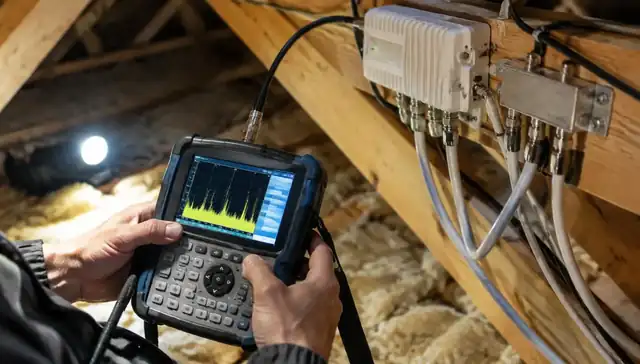
Many Suburb homes favour discreet aerial positions, and generally useful reception makes a loft installation worth testing. However, roof coverings, stored items and nearby metal can change what reaches the aerial. We compare the available signal with the feed leaving the loft rather than assuming indoor positioning is the problem.
Around Big Wood, foliage is another consideration, not a diagnosis on its own. We look at the actual direction of reception and the margin available on each multiplex. Moving an aerial inside the loft may be worth a controlled trial, but we measure the result before calling that a solution.
Follow the cable through the house
Older houses can contain several generations of television wiring. A visible socket may connect to a hidden splitter, an unused amplifier or a cable left behind during alterations. We ask which rooms you need and map the agreed feeds, avoiding unnecessary disturbance to decorated walls and original joinery.
A typical job here: the downstairs television works while an upstairs room loses HD pictures. We compare both branches against their common input. If one branch introduces the errors, we narrow the investigation to its connectors, socket and cable. There is no reason to replace a sound aerial merely because one room fails.
Local cable and aerial repairs →Additional television outlets →
Quality readings matter more than a full strength bar
Our meter checks signal level alongside MER, which describes modulation quality, and BER, which shows data errors. We compare those readings at accessible points before and after amplification or splitting. A strong reading with damaged data can still produce a picture that freezes repeatedly.
We also inspect the frequency spectrum when interference is suspected. A filter is useful only when the unwanted signal and its entry point justify it. We check whether excessive amplifier gain is making matters worse, and compare the effect of any adjustment across the television groups, not just one channel.
Respect the building while arranging access
Near Henrietta Barnett School and elsewhere in the Suburb, design controls must be considered before exterior changes. We distinguish testing an existing system from proposals for a new visible mounting or cable route. Where approval is needed from the Trust, owner or planning authority, we establish that before the proposed alteration proceeds.
Please tell us about awkward loft hatches, boarded areas and shared roof ownership when booking. We do not walk on unsupported ceilings or improvise access across fragile coverings. If roof access needs separate equipment, our findings explain what remains untested and how that affects the next stage.
Separate dish reception from aerial reception
A satellite box reporting no signal needs different measurements from a Freeview television. We establish which service supplies the missing programme, check the receiver's feed requirements and examine accessible satellite connections. Compatible test equipment lets us assess signal quality without assuming that the dish has shifted.
Where the fault affects only one satellite input, we compare the relevant feeds and inspect their terminations. Any LNB replacement must suit the receiver system. If the equipment is communal, we need permission to investigate shared components; changing them without coordination could interrupt reception in neighbouring homes.
Leave a clear diagnosis, not an unexplained box
After identifying the cause, we describe the necessary repair and provide a clear price before work starts. When you approve the work, we repeat the relevant measurements and demonstrate reception at the agreed outlets. If a weather-related fault is absent, we report the limits of the visit honestly.
For free advice, ring 0800 206 2385 or send WhatsApp details to 07595 292534. We answer Mon-Sat, 8am-7pm, with same-day appointments where possible and outdoor work up to sunset. Our base is Britannia Road, Finchley N12 9RU, and we bring 25 years' experience to the investigation.