
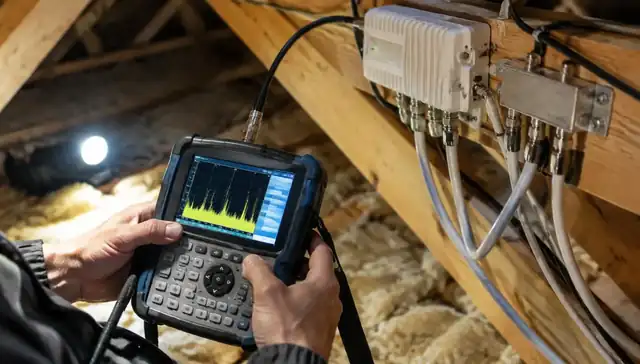
A television showing full signal strength can still freeze every few seconds. We see the same trap with boosters: more level, more breakup. We measure the quality of the broadcast and trace it through your system. That gives us evidence for the repair we recommend.
We have 25 years' experience working on aerial and satellite systems around Finchley and North London. Our fault-finding visits cover intermittent reception, missing multiplexes, one-room failures and 4G/5G interference. Call us free on 0800 206 2385, Mon–Sat 8am–7pm. We offer same-day service where possible and a clear price before work starts.
Tell us the pattern before we open the toolbox
We ask which channels fail, which rooms lose them and whether the fault follows rain, wind or a particular time of day. Tell us about recent building work, a new television or an amplifier moved into a different cupboard. Small details help us choose where to start measuring.
Keep a short record of intermittent faults: channel name, time, weather and duration. A photograph of the error message helps too. Avoid repeated retunes during an outage. We need to restore reception before rebuilding the channel list. Keep clear of roof equipment and leave powered communal units closed.
MER and BER: the numbers behind a stable picture
We measure signal level alongside modulation error ratio, or MER, and bit error rate, or BER. MER tells us how cleanly the received signal represents the transmitted data. BER tells us about errors, with readings taken at the correction stages supported by the meter. We explain those results in ordinary language.
We compare readings across the multiplexes instead of checking a single favourite channel. A damaged cable or interference source can hurt one frequency group much more than another. We look for enough reception margin to keep the picture stable as conditions change. We record where the quality changes along the signal path.
Aerial, amplifier, splitter, every socket
We work through the chain in order: aerial output, amplifier input and output, splitter branches and every socket in the agreed system. We compare the meter at each point. If roof access needs specialist equipment, we identify that before booking roof tests. We state exactly which points we have measured.
Here is a typical N12 diagnosis: all upstairs televisions fail while the lounge stays clear. We compare the incoming feed with both distribution branches. A sharp quality drop after one splitter connection sends us to that joint and cable. We repair the identified fault, then repeat the same measurements to verify the result.
- Signal level, MER and BER checks across the received multiplexes
- Amplifier power-supply and gain checks
- Cable, connector, splitter and wall-socket inspection
- Receiver and flylead checks at affected televisions
- Recorded findings and an agreed repair scope
Detecting 4G/5G interference properly
We use the meter's spectrum view to examine unwanted signals alongside the television transmissions. Strong mobile signals can overload an amplifier or tuner. We compare readings with suitable filtering and check the effect at the affected outlets. Poor MER alone does not identify a mobile transmitter as the cause.
Where filtering is needed, we put it ahead of the overloaded component. We also inspect cable screening and flyleads. Household interference needs a different investigation: we compare the fault timing with lights, plug-in power supplies and other equipment. We ask you to operate accessible controls while we watch the readings.
Intermittent faults need a repeatable test
Water inside coax, a loose centre conductor and a failing amplifier supply behave differently as conditions change. We inspect the physical installation as well as the signal. Chimney lashings, cable clips and unsupported joints all matter when a picture fails during gusts. We check safe, accessible connections without disturbing live shared services.
A typical wet-weather case in a Muswell Hill Victorian terrace starts with clear pictures on a dry visit. We inspect the external cable jacket and joints, compare the available reception margin and use the owner's fault log. If the fault stays absent, we document the checks and agree the next observation. We do not claim a confirmed diagnosis without evidence.
Local reception changes street by street
We work across N12, N2, N6 and NW11, from Finchley and Highgate to Hampstead and Golders Green. We measure Crystal Palace reception against the actual roof position. Hills, tall buildings and reflections alter the result. The direction of the next-door aerial is a starting clue, never a measurement.
We assess the Alexandra Palace relay when it offers a useful reception option and explain its smaller multiplex selection. In Hendon and Colindale mansion blocks, we check the communal feed before recommending work inside a flat. We arrange keys and managing-agent permission for headend cupboards, risers and roof equipment.
Satellite faults and damaged cable runs
For satellite reception, we test the dish feed, LNB supply and relevant cable paths. We check alignment and compare feeds when one receiver works and another fails. A dish movement and a damaged connector need different repairs. We explain which tests support our recommendation before changing parts.
Where a cable run needs renewal, we specify WF100 screened cable and an agreed route. We retain sound equipment. If the repair belongs on the roof, we inspect the mounting and access first. We provide a fixed written quote for the work and explain any access equipment needed.
You get the findings and the next step
We explain where the signal deteriorates, what needs repair and what we tested after the fix. Straightforward faults are often resolved during the visit once you approve the price. If further access or monitoring is needed, we agree that next step with you. Call 0800 206 2385 to book.