
The red-brick mansion blocks and converted Victorian houses around West End Lane do not all distribute television signals in the same way. We establish how your building is connected before proposing changes. Good general reception outside does not rule out a failing communal amplifier or a damaged branch serving one home.
Begin at the boundary of the flat
We ask whether your socket belongs to a communal aerial, a private aerial or an integrated aerial and satellite system. If you are unsure, a photograph of the wall plate helps us prepare. We then compare the supplied signal with what reaches the television, using a known suitable lead when appropriate.
That comparison matters in conversions near Fortune Green, where an old cable may pass through another part of the house before reaching your room. We cannot assume every visible lead belongs to your flat. We trace accessible connections and explain when a concealed section or locked distribution point limits the diagnosis.
Access permission can be the missing part of the visit
A meter inside your lounge cannot tell us everything about a roof-level distribution cabinet. Where shared equipment needs examination, we ask for the managing agent's approval and access arrangements. Please identify who holds keys to service cupboards and whether there are restrictions on roof entry before the appointment.
We avoid disconnecting a common feed just to see what happens. Other residents may depend on that connection. If wider tests require an interruption, we agree it with the responsible person first. Our findings distinguish an internal flat repair from work that belongs to the building, helping you pass a useful explanation to the agent.
An amplifier must be tested on both sides
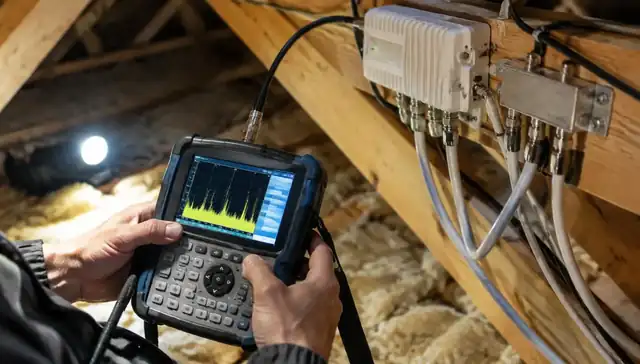
Older shared systems can leave individual frequency groups weak or distorted even when the roof aerial is receiving well. We compare the input, output and relevant branches where accessible. Power-supply condition, amplifier gain and connection quality all matter; a lit indicator alone does not prove the unit is performing correctly.
We measure level alongside MER, the modulation error ratio, and BER, the bit error rate. Those quality readings help distinguish a clean but attenuated feed from a strong, damaged one. Simply increasing amplification may raise the level while making the actual decoding less reliable. We choose the remedy from the comparison, not the age of the box.
When one room fails and another remains watchable
A typical job here: a converted house off West End Lane has stable reception in the front room and missing services at the rear outlet. We compare both sockets on the same multiplexes, examine the split and check the extension lead. The difference narrows the search before anyone considers changing equipment on the roof.
An unused splitter, poorly terminated plug or crushed coax behind furniture can reduce the available margin. We inspect accessible runs without pulling blindly on concealed cable. If renewal is justified, we discuss a route that respects the decorated rooms and any common hallway, then quote for that specific repair.
Missing HD is not a complete diagnosis
We check which services are absent and whether the receiver supports the broadcast format. Multiple missing channels can share a multiplex, making the pattern more informative than the channel count. A receiver limitation needs a different answer from poor delivery of that multiplex through a shared system.
Please leave repeated retuning until reception has been checked. A scan during a failure may replace a partly usable list with an empty one. Once the feed is stable, we can check tuning and the selected transmitter. Crystal Palace is assessed from the actual installation, rather than assumed solely from the postcode.
Freeview help in West Hampstead →Crystal Palace reception guide →
Track the fault that appears only in the evening
If reception fails at particular times, note the channel, duration and what else is operating. We consider electrical interference, changing conditions and unstable powered equipment without treating any one as established. Testing while you use an ordinary light switch or appliance control can help reveal a repeatable relationship.
Mobile signals are assessed through the spectrum and comparative filtering tests where appropriate. We also look at screening and connectors. Rain-related trouble prompts inspection of exposed cable and joints, subject to safe access. When the symptom cannot be reproduced, we state that clearly rather than converting a possibility into a confirmed repair recommendation.
Investigating 4G and 5G effects →Nearby Kilburn investigations →
Dish feeds need their own test sequence
A combined wall plate can carry satellite and terrestrial services on separate connections. We establish which outlet and receiver are involved before testing. For a satellite failure, we check relevant feed paths, LNB supply and receiver compatibility; the aerial measurements alone cannot explain a dish reception problem.
In a mansion block, satellite distribution may require an authorised specialist check at the communal equipment. For a private dish we assess accessible connectors, obstruction and alignment. We retain usable parts and explain whether a cable defect, feed arrangement or dish-side issue is supported by the tests.
Arrange a measured answer, with the cost agreed
We are Finchley Aerials and Satellites, with 25 years' experience and a base at Britannia Road, Finchley N12 9RU. You can call 0800 206 2385 without call charges, or WhatsApp 07595 292534. We give free initial advice and explain the diagnostic visit arrangements when booking.
Contact hours are Monday to Saturday, 8am to 7pm, with outdoor work continuing only until sunset. We offer same-day service where possible. Tell us about parking, entryphones and access around West Hampstead Thameslink. After diagnosis, we give a fixed written quote for recommended work and recheck the affected feed after an approved repair.