
We diagnose reception across NW6, from Victorian terraces and Queen's Park cottages to post-war estates. Dense mobile coverage makes interference worth checking, but we require evidence rather than treating every nearby mast as the explanation.
Do not add gain before we know what is wrong
A television strength bar cannot tell you whether extra amplification will help. Too much level can drive equipment into distortion, while a poor source remains poor however loudly it is amplified. We inspect existing booster settings and compare the input with the output before recommending a different arrangement.
Around Kilburn High Road, blocks and houses have very different distribution needs. One set connected directly to a roof feed is not the same load as several rooms behind splitters. We calculate the practical issue from measurements at your property, keeping useful amplification and removing or correcting it only where tests show that it harms reception.
Turn the symptom into a test sequence
Please tell us whether channels vanish together, whether the sound stutters and how long the interruption lasts. We ask about new equipment, changed cables and building work as well as wind or rain. Keep the original tuning during a sudden outage so that a lost feed does not become a lost programme list as well.
A useful comparison is another television on the same installation. If only one fails, we start with its lead, input and outlet; if every room fails, we work towards the common source. Neither pattern is absolute proof, but it gives a sensible order to the meter tests and avoids unnecessary disruption.
Measure the data quality on each multiplex
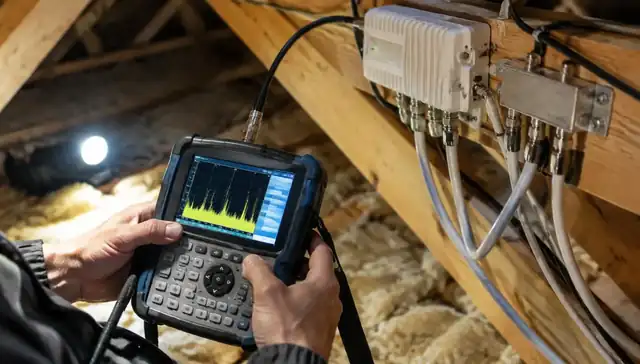
We record signal level and assess MER, modulation error ratio, together with BER, bit error rate. These describe different aspects of reception. Clean modulation and low error performance matter more than an impressive percentage displayed by a tuner, and readings from one channel group cannot stand in for the rest.
Where access permits, comparisons run from the aerial through any amplifier and splitter to the agreed outlets. We explain which stage introduces deterioration. If a feed remains clean until a bedroom branch, there is no sound basis for replacing the aerial simply because it is old. We focus the repair on the part that fails the comparison.
Mobile filtering has to survive a before-and-after test
We use spectrum measurements to look for unwanted signals that may overload a wideband amplifier or receiver. In Kilburn, 4G/5G interference is a relevant possibility, not a diagnosis attached to the postcode. We compare quality with suitable filtering and check whether the affected television multiplexes recover.
Any filter must protect the component that is being overloaded. Fitting it after distortion has already occurred may leave the problem untouched. We check its position, any power-passing requirements and the condition of screened connections. If the improvement is absent or inconclusive, we say so and continue with cable, power and receiver checks rather than selling an explanation unsupported by the meter.
Queen's Park cottages need proportionate access plans
An external repair must suit the building as well as the electrical fault. We inspect the proposed access, cable route and existing mount before agreeing work at height. We check relevant permissions for altered external positions and avoid drilling new routes through finished interiors without discussing them.
A fault following rain leads us to weatherproofing, cracked jackets and exposed joints. Movement during gusts raises questions about support and fixings, but inspection must confirm them. We never ask you to climb up for a closer look. A photograph taken safely from ground level can help us plan equipment without pretending it replaces an on-site assessment.
Estate feeds and converted-house branches
In Brondesbury flats or post-war estates, reception can depend on equipment belonging to the building rather than the occupier. We establish who controls the shared system and arrange access through that person. Our first domestic tests help show whether the fault lies beyond the flat's own wiring.
We inspect accessible branch connections, wall plates and leads without interrupting neighbours. If further communal tests are needed, we provide a clear explanation of the relevant readings and proposed next step. A working feed elsewhere does not clear every tap or riser, and one failed flat does not justify a whole-system replacement. Responsibility and scope stay explicit throughout.
Intermittent does not mean imaginary
Faults can change with temperature, moisture or the operation of nearby electrical equipment. Record the time, affected programme and anything that switched on nearby. We can compare that pattern against meter behaviour and inspect likely components, but we do not name a culprit just because the picture improves when we arrive.
Following an approved fix, we repeat the relevant measurements and run the normal receivers at the agreed outlets. We check that the original symptom has gone where it can be reproduced. Where uncertainty remains, we explain monitoring or return-access options. A realistic account of what we proved is more useful than an unconditional promise about every future viewing condition.
Arrange diagnosis before committing to replacements
Finchley Aerials brings 25 years' experience to Kilburn TV investigations. Call free on 0800 206 2385, Mon-Sat 8am-7pm, or message 07595 292534 on WhatsApp. We offer free advice and same-day service where possible; roof access and available daylight affect what can be completed, with on-site work ending by sunset.
Give us the NW6 address, number of rooms and any managing-agent contact needed for access. We set out the visit arrangements and a clear price before work starts. Repairs are offered on a fixed written quote, so a diagnostic visit does not turn into a string of unexplained equipment changes.