
Willesden Green, Harlesden and the streets around Roundwood Park contain plenty of converted terraces. Their cable arrangements can be less straightforward than the frontage suggests. We establish which equipment serves your home, who controls it and where we can safely test before proposing changes.
Draw the boundary around the fault
Start by telling us whether every television is affected. We ask which programmes disappear, whether sound continues and what the screen actually says. A receiver reporting no signal needs a different investigation from a television showing no picture from an HDMI input. We check the selected source before following the aerial cable.
In a subdivided Victorian house, two sockets beside each other may belong to different installations. We trace accessible connections rather than assuming the wiring follows the room layout. Let us know about locked cupboards, landlord equipment and any other occupants who need to be present.
A good roof signal can be lost downstairs
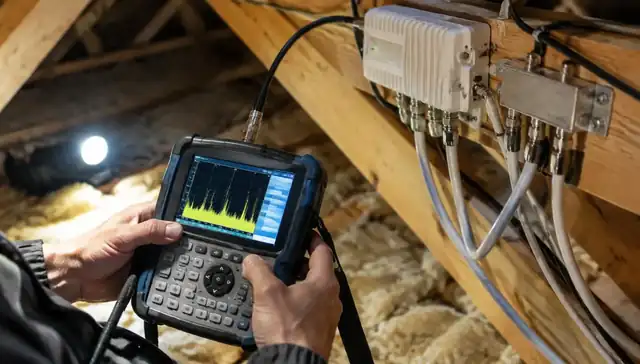
Reception across Willesden is generally strong, so we pay close attention to distribution losses and unwanted amplification. Our meter measures level, modulation error ratio and bit error rate. Together these show whether a feed has usable quality, rather than merely a large signal-strength bar on the TV menu.
We compare the received multiplexes, which are groups of broadcast channels, at accessible stages. A deterioration after one connection narrows the search. We inspect that cable section, socket or distribution unit before condemning equipment farther upstream. Where roof measurements need additional access equipment, we explain the limitation and agree the arrangements.
Separate flats should not depend on a neighbour's plug
A typical job here: a converted Edwardian terrace near Roundwood Park has a working ground-floor outlet but unreliable reception above. We compare the branches and check how the amplifier receives power. If its supply is inside somebody else's flat, switching off that socket can interrupt more than one household.
We explain the arrangement we find and distinguish a failed supply from unsuitable shared distribution. We will not disconnect other residents to prove a point. Alterations to communal equipment require the appropriate permission, and access to the headend or roof may need the managing agent rather than the individual tenant.
Inspect the small parts before buying large ones
A crushed flylead behind a cabinet, a loose wall plate or a poorly fitted connector can spoil a perfectly serviceable aerial feed. We test with a suitable known-working lead and examine accessible terminations. Old extensions through several rooms deserve particular attention when only the last television loses channels.
Outside, split cable sheathing and unprotected joints can admit moisture. We check the route as well as its ends, including unsupported loops that move in wind. If renewal is necessary, we discuss the path through your terrace or conversion before work begins, keeping sound wiring wherever its condition and measurements justify retention.
Interference is a finding, not a postcode assumption
We investigate mobile-signal interference with spectrum readings and an appropriate filter comparison where indicated. Fitting a filter to every NW10 aerial would not establish the cause. An amplifier driven too hard, damaged screening and a faulty domestic power supply can each produce symptoms that look similar on screen.
If breakup coincides with a light or appliance being switched on, make a note. We can compare readings while you operate ordinary accessible controls. Leave electrical covers and powered distribution units closed. Where the evidence points outside the TV installation, we explain that boundary rather than selling aerial parts to mask it.
Do not erase the clues with repeated retuning
Retuning while reception is absent may remove channels from the stored list without fixing anything. Keep the existing list if possible and tell us which groups fail. We restore a reliable feed first, then check tuning and receiver compatibility where required. Missing HD services can involve receiver capability as well as reception.
Crystal Palace is a transmitter we assess locally. If an alternative such as the Alexandra Palace relay is considered, we explain its reduced channel selection before changing alignment. We do not choose a transmitter solely because a neighbouring aerial points that way, or promise identical reception throughout Harlesden and Willesden Green.
Leave with an explanation you can use
After an authorised repair we repeat the relevant measurements and demonstrate the affected programmes. You hear where the loss occurred, what changed and which outlets were checked. If an intermittent fault remains absent during testing, we say so and agree useful observations instead of describing a suspicion as a confirmed failure.
Finchley Aerials and Satellites has 25 years' experience and is based on Britannia Road, Finchley N12 9RU. Phone 0800 206 2385 free or send your postcode to WhatsApp 07595 292534. We offer free advice, answer Mon-Sat 8am-7pm and work on site until sunset. Same-day attendance depends on availability; we agree diagnostic charges and give a clear price before work starts.