
Kingsbury's older semis and terraces often combine a chimney aerial with several generations of indoor wiring. We separate faults in that wiring from reception problems outside. You get an explanation of the evidence, not a shopping list of equipment that might help.
Which rooms fail is our first useful clue
Before moving anything, tell us whether the problem affects one channel group, one room or the whole property. Check whether your television is using its aerial input or an internet app: a frozen stream needs a different investigation. We ask about new extension leads, moved furniture and any aerial cable disturbed during decorating.
In a Kingsbury Road terrace, a feed may pass through a front room before reaching a rear extension. A loose joint there can interrupt several sets without affecting the roof signal. We sketch the connections we can establish and agree which outlets the visit covers, including any recorder between the socket and television.
Good NW9 coverage does not prove the installation is sound
Crystal Palace generally serves Kingsbury well. That makes it particularly important to test an ageing installation rather than blaming the neighbourhood. On 1920s and 1930s houses near Roe Green Park, exposed coax, old chimney fixings and additional splitters all deserve attention. We inspect what is present without assuming its age proves failure.
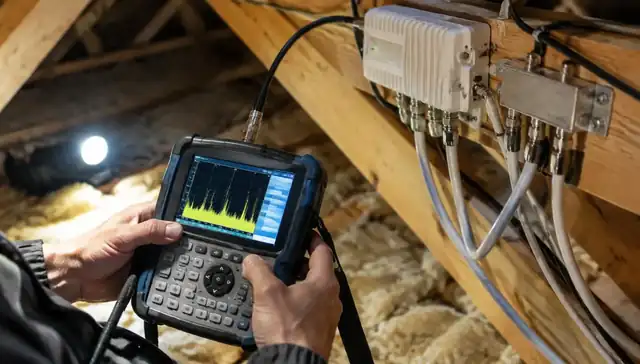
We compare digital signal quality across the available multiplexes, the groups carrying television channels. Level alone cannot show whether the data is arriving cleanly. Our meter measures MER and BER alongside strength, helping distinguish a weak feed from distortion. We explain the significant differences without expecting you to interpret an engineer's display.
Understanding picture breakup →Aerial repairs around Kingsbury →
Follow the cable through the house
We compare accessible points along the route: the incoming feed, distribution equipment and affected wall outlets. Testing both sides of a splitter helps show whether a particular branch introduces the loss. We also substitute a suitable flylead, because damage behind a television can look remarkably like trouble on the chimney.
Extra rooms added over time can leave unused branches, hidden joins and amplifiers powering nothing. We identify their purpose before disconnecting them. Where a cable disappears behind fitted furniture or finished walls, we describe the limits of the test and discuss an accessible alternative route rather than opening surfaces without your agreement.
Rain and gusts give different evidence
If reception fails during rain, note whether it returns as soon as the shower stops or remains poor afterwards. Water entering an outside connection can travel along a cable. We inspect reachable joints and the cable jacket, then compare readings with the weather pattern you describe. A dry visit cannot always reproduce that behaviour.
Towards Fryent Country Park, vegetation and roof exposure also deserve a position check. We do not diagnose trees from a postcode alone. Movement in an insecure aerial mounting, a damaged downlead and an obstructed signal path require different remedies. Roof inspection depends on safe access; we explain any additional access arrangements before committing to elevated work.
Discuss access before booking →Neighbouring Colindale diagnostics →
Test a booster instead of turning it up
An amplifier can raise a poor signal without cleaning it. We check its supply, input quality and output, looking for excess gain as well as insufficient level. If every set fails together, a disconnected power unit is worth checking before anyone orders another aerial. Leave mains-powered equipment closed for us to inspect safely.
Mobile interference is another possibility, not a default explanation. We examine the spectrum and compare performance with appropriate filtering when the readings justify it. The filter must protect the component being overloaded. We also consider poorly screened leads and interference from household equipment, particularly when breakup follows a light or appliance switching on.
Flats and satellite feeds need the right boundary
For a Kingsbury flat, we establish whether the socket belongs to a shared aerial system. Ask the managing agent about access to distribution cupboards and whether neighbours are affected. We can test the flat's accessible outlet first, but changes to shared equipment require authorisation. Your own television failing does not prove the communal aerial has failed.
Satellite reception takes a separate set of checks. We identify the receiver and feed arrangement, inspect accessible connectors and test the relevant dish cable. A fault on one satellite output can leave another receiver working. We keep those results distinct from terrestrial aerial readings, so the proposed repair addresses the service you actually use.
Agree the remedy, then check it at the television
After diagnosis we set out the repair and give a clear price before work starts. That may mean renewing a connector, correcting distribution or replacing a damaged cable rather than changing every component. Once authorised work is complete, we repeat the relevant tests and check reception at the outlets within our agreed scope.
Finchley Aerials and Satellites brings 25 years' experience from Britannia Road, Finchley N12 9RU. Call free on 0800 206 2385 or send your symptoms by WhatsApp to 07595 292534. Our hours are Mon-Sat, 8am-7pm, with site work until sunset. We offer free advice and same-day attendance where possible, subject to access and availability.