
Our NW10 approach suits Victorian and Edwardian terraces, converted houses and newer developments alike: understand the wiring, measure the fault and agree the work. If a screen is freezing or several stations have vanished, tell us what still works as well as what does not.
Converted houses need clearly separated feeds
A house divided into flats may contain cables from several rounds of alterations. Some are live, some are abandoned and others run through spaces the current occupier cannot access. We establish which feed serves your flat before disconnecting anything, especially where a single roof aerial supplies multiple homes.
Near Willesden Green, a fault reported by one resident may belong to an individual branch rather than the shared aerial. We compare your socket with the accessible distribution point and check whether neighbours are affected. Where communal equipment needs repair, we arrange authorisation instead of treating shared wiring as though it belongs to one customer.
A working roof aerial can stay where it is
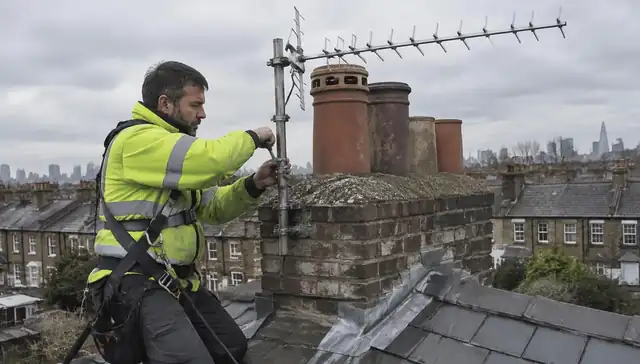
Willesden generally has strong reception, so a complete replacement is not our starting assumption. We measure the incoming signal and inspect the aerial, bracket and mast. If those are sound and delivering usable quality, we concentrate on the section that loses or corrupts it on the way indoors.
There are genuine reasons to replace rooftop equipment: broken elements, severe corrosion or a mounting arrangement that cannot safely be retained. We explain those findings separately from indoor faults. You receive the proposed scope and a fixed written quote rather than a vague recommendation to replace everything because the television has stopped working.
Trace the weak point behind the wall plate
We begin with accessible connections, checking the flylead and socket before following the installed cable. A loose conductor, damaged screening or poorly terminated plate can disrupt reception without looking dramatic. Our meter lets us compare the feed before and after each component instead of relying on the television's strength display.
A typical job here: in a terrace conversion near Roundwood Park, one flat receives a poor picture while another remains clear. We isolate a defective branch connection, repair it and verify both feeds. The shared roof aerial stays untouched because the fault is in the distribution, not the reception position.
Too many splitters can undo a good signal
Each passive split reduces the level available to individual outputs. We look for unnecessary cascades, disconnected extensions and old adaptors hidden behind furniture. Removing redundant losses can be more useful than adding an amplifier, provided the revised arrangement still supplies all the rooms you actually use.
Where powered distribution is needed, we check supply compatibility and output levels across the branches. Excessive gain is a fault too. We also investigate interference if the quality readings suggest it, testing suitable filtering rather than promising that a generic booster will cure every missing channel. The recommendation follows the evidence.
External repairs that stand up to rain
Terraced frontages can have long drops of coax exposed to sunlight, wind and previous building work. We examine the cable jacket, clips and outdoor joints when symptoms follow wet weather. Water can travel inside the cable, so a fresh connector alone may leave the source of the problem untouched.
We agree any replacement route before fitting screened coax, protecting entries and securing the run neatly. In conversions, the most convenient route for one flat may cross another resident's wall or window. We settle permission and access first, and keep redundant wiring separate from any active feed we are not authorised to alter.
Reaching the roof without disrupting the building
Around Harlesden, tell us whether access is through a shared hall, a rear yard or a locked side gate. Parking arrangements and space for equipment matter, particularly if the repair needs more than an indoor socket test. We confirm what is needed before arriving rather than expecting residents to improvise roof access.
We inspect supporting masonry and work only when conditions are suitable. An unstable chimney requires attention before it can support aerial equipment. Where conservation controls, lease conditions or listed status affect external changes, we flag the relevant permission. We can explain the reception repair without overriding the building owner's responsibilities.
Restore the signal before rebuilding the channel list
Avoid repeated tuning attempts when the picture suddenly disappears. Scanning an empty feed can remove the stored services and make the fault seem more extensive. Keep a note of the missing stations and whether the trouble occurs on every television; those details remain useful even if reception returns temporarily.
Once the repair is complete, we recheck quality and error readings, then tune if required. We demonstrate live channels on the equipment covered by the visit and explain the difference between an aerial fault and an internet streaming problem. A working app does not prove that the television's broadcast feed is healthy.
Booking practical help in NW10
You can reach Finchley Aerials and Satellites free on 0800 206 2385, Monday-Saturday between 8am and 7pm. WhatsApp 07595 292534 is useful for sending your postcode and a description of the setup. Please mention if a landlord or agent must approve shared-system work.
From our Britannia Road base in Finchley N12 9RU, we bring 25 years of experience to reception repairs. We offer free advice and same-day visits when feasible, with outside work ending by sunset. We discuss the findings and agree the repair cost before proceeding; unexpected additional work is put to you for approval.