
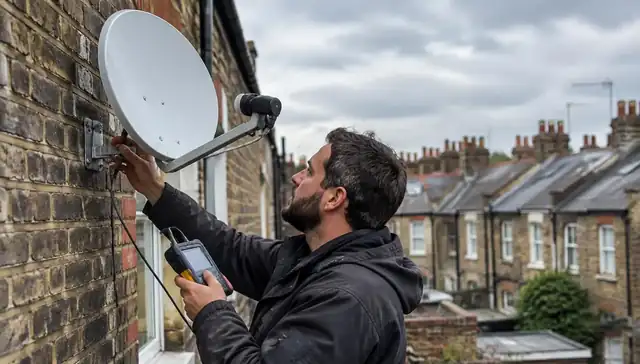
We fit, relocate and repair satellite receiving equipment throughout NW6. Red-brick blocks and Victorian conversions call for careful cable planning as well as accurate alignment. We keep those decisions together, so the proposed system suits your receiver, your room and the building rather than simply filling an empty socket.
Understand the building before booking roof work
Tell us whether you own the whole property, lease a flat or rent. We ask who controls the roof, external walls and service cupboards. Even where an old dish is visible outside your window, it may belong to another resident or form part of equipment maintained for the block.
We can inspect accessible private feeds and explain what further access is needed. Alterations to shared infrastructure require the responsible party's agreement. Getting that organised early avoids a visit that cannot progress because a cupboard is locked or permission only covers work inside the flat.
Sky Q and Freesat need a model-specific plan
A pair of threaded outlets does not guarantee support for your chosen receiver. We identify the feed arrangement and check the box specification. Sky Q usually needs a different arrangement from older Sky equipment, while Freesat requirements vary between generations. A communal installation adds its own distribution compatibility checks.
For a private dish, the answer may involve replacing the LNB on its arm while retaining the reflector and cables. For a block, compatible distribution equipment may be necessary instead. We describe the required changes without assuming that every visible component must be renewed. Subscriptions remain a matter for your provider.
Our independent satellite service →Discuss receiver compatibility →
Discreet positioning around Fortune Green
We look for a position that combines a clear satellite path with a sensible appearance. A rear elevation can work, but hiding equipment behind brick or a neighbouring roof blocks reception. The relevant satellites for normal Sky and Freesat viewing are at 28.2 degrees east; the dish cannot simply face whichever gap looks convenient.
Around Fortune Green and West End Lane, we assess the individual property rather than presume every address has the same restrictions. Conservation controls, listed status and lease conditions can affect external work. We flag the checks you need to make and wait for required consents before fixing equipment to the building.
Cable routes that respect a conversion's layout
A top-floor receiver and a rear-mounted dish can leave a long route through a Victorian conversion. We discuss external clipping, existing service routes and room entry before drilling. We do not assume access through another flat or across a neighbour's balcony is available just because it shortens the cable.
Where coax is already present, we test it and identify its destination. New runs use suitable screened satellite cable, with protected outdoor connections and sealed entries. We avoid tight bends and trapped sections at windows. Inside, the route should leave the equipment usable without creating loose cable along a shared landing.
Installation planning in NW6 →Nearby Kilburn satellite service →
When a shared feed works for everyone except you
We compare the signal arriving at your outlet with the receiver's requirements. A faulty flylead, unsuitable plate or damaged branch cable can mimic a rooftop problem. Knowing whether neighbours are affected helps narrow the investigation, but we still test the individual feed rather than treating their working picture as conclusive evidence.
If the fault lies upstream, we explain the findings to whoever authorises communal maintenance. Where access is approved, we inspect the relevant distribution equipment. We keep changes controlled and identify the affected connection so that restoring your television does not disconnect another flat or introduce an incompatible feed.
Repair a moving dish before adjusting its aim
A wind-sensitive picture can originate in a loose mount, tired fixings or cable connections that move with the bracket. We inspect the support first. Setting perfect alignment on a dish which shifts as soon as the ladder is removed is not a repair we would consider complete.
We also look for water damage, corrosion and an obstructed path following scaffolding or nearby building work. Once the structure and connections are sound, we adjust direction, elevation and LNB skew using measured quality. Sound existing equipment stays in service where it meets the requirements of the installation.
A useful handover includes the receiver indoors
We check reception over suitable transponders rather than declaring success after seeing one programme. Where the receiver supports recording, we confirm its feeds and demonstrate the available functions. We show you which connection serves which purpose, especially when unused cables remain from previous installations.
Signal quality can fall in severe weather, so no installer can sensibly promise uninterrupted satellite pictures in every storm. We explain any site limitations and deal with avoidable weaknesses such as poor alignment or damp coax. A dependable installation needs both an accurately set dish and a healthy route indoors.
Tell us about access when arranging a visit
Let us know about entry phones, roof keys, permitted working hours and parking arrangements near your building. Send the receiver model and a safely taken dish photograph if possible. We offer free advice on 0800 206 2385, or you can contact us by WhatsApp using 07595 292534.
Finchley Aerials and Satellites has 25 years' experience and is based at Britannia Road, Finchley N12 9RU. We answer Mon-Sat between 8am and 7pm, with site work possible until sunset. Ask about same-day availability. We set out the agreed work in a fixed written quote before installation begins.