
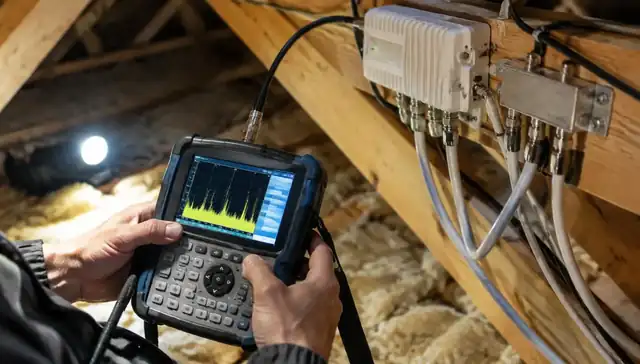
We investigate missing services, pixelation and intermittent reception with meter readings, not a sequence of speculative replacements. White stucco houses, mansion flats and converted period properties all need care over shared access. We explain what we can test inside your home and what needs approval from whoever manages the building.
Is the problem yours or shared?
Ask whether another flat has the same missing channels, but do not unplug communal equipment to investigate. A building-wide failure suggests a different starting point from one television losing reception. We compare your accessible outlet with the incoming branch where permission allows, recording which parts of the system we actually reach.
Older conversions sometimes contain several generations of wiring. We trace the active feed and identify unused sockets so an abandoned cable is not mistaken for an aerial failure. If the managing agent holds the distribution cupboard key, arranging it in advance lets us take the investigation beyond the room plate without an avoidable delay.
Establishing what reaches the room
At your television we separate the flylead and receiver from the fixed wiring. A poor plug can turn a healthy wall feed into an unreliable picture. We test at the socket directly, then compare the complete connection, keeping the original arrangement available until we understand the change.
We also ask which source is affected. Broadcast reception, a streaming app and a connected player use different paths into the screen. A working app does not prove the aerial is healthy, and a slow internet connection does not explain damaged terrestrial signal readings. Establishing that distinction saves unnecessary work on the wrong system.
Belsize Park area information →Mobile interference explained →
MER, BER and the multiplex comparison
Our meter measures level, modulation error ratio and bit error rate. We use MER to assess signal cleanliness and BER to examine data errors, interpreting the correction stages available on the instrument. The figures tell us more than a television strength bar, especially when an amplifier produces a high level but poor quality.
We test the frequency groups carrying the received channels. One damaged multiplex can account for several missing services at once. By comparing these groups at successive points, we can investigate a frequency-sensitive cable problem, distribution loss or interference without assuming that every channel failure has the same cause.
Looking at the building, not only the skyline
Reception around Belsize Village and Swiss Cottage is generally promising, but neighbouring rooflines and tall buildings still affect an individual feed. We assess the existing aerial output before discussing a different position. A rooftop installation that supplies several flats needs a broader test plan than one household's cable.
Where exterior access is required, we agree permissions and safe working arrangements first. Period detailing, shared entrances and the route through the building all influence how equipment can be reached. We do not treat a communal roof as an extension of a private balcony or assume a tenant can authorise changes for the whole block.
Mobile interference needs evidence
A 4G or 5G signal can overload susceptible equipment even though the wanted television transmissions remain present. We use spectrum checks and controlled filter comparisons to establish whether that mechanism fits the fault. The presence of mobile coverage in NW3 is not enough to blame it for every evening freeze.
If filtering is justified, placement matters. We protect the vulnerable stage before it overloads and check the effect on the wanted broadcasts. We examine cable screening too. A loose connector or poorly screened lead may need repair rather than an extra box hidden behind the set, and we explain the distinction before quoting.
Belsize Park area information →Understanding picture breakup →
Tracing the distribution branch
In a mansion block we compare the communal input, accessible distribution outputs and the affected branch as authorised. In a converted villa the arrangement may be a smaller splitter and amplifier. Either way, the useful question is where a measurable deterioration first appears, not how old the cabinet looks.
We check amplifier power and gain alongside the cable route. A typical job here: one flat loses a channel group while another remains clear. We compare their authorised branch points and the room outlet, then isolate the failed connection or component. The illustration is a diagnostic sequence, not a reason to replace a building's entire aerial system.
What we leave you with
After diagnosis, we describe the evidence, any access limitations and the proposed repair. You receive a fixed written quote before approving further work. If shared equipment is responsible, we can explain the findings for the managing agent rather than fitting private parts that cannot correct an upstream fault.
Following an agreed repair, we repeat the key readings and check the affected television. Additional outlets are tested within the agreed scope. If the symptom stays absent throughout the appointment, we record that honestly and suggest useful observations. We will not label a fault solved merely because the picture happens to be working as we leave.
Booking around communal access
Call Finchley Aerials on 0800 206 2385, free, or send WhatsApp details to 07595 292534. Our telephone hours are Monday to Saturday, 8am-7pm. We offer free advice and same-day visits where practical, with on-site work continuing until sunset when access and conditions allow.
We have 25 years' experience and are based at Britannia Road, Finchley N12 9RU. Tell us the flat number, managing contact, available keys and parking arrangements when booking. We agree a clear price before work starts and plan the visit around the actual system, not simply the number of televisions in your lounge.