
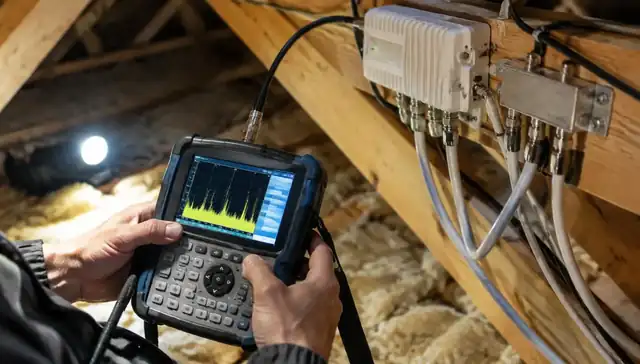
We start by identifying the affected service and the route that supplies it. From Camden Market towards Regent's Canal and Primrose Hill, building arrangements matter more than assumptions about central London coverage. Our work focuses on measured causes of freezing, missing channels and complete signal loss, with sound equipment retained wherever it remains suitable.
Separate broadcast trouble from a screen problem
Tell us whether the fault occurs on terrestrial channels, satellite reception or an app. The same screen can display all three, but their connections and failure points differ. We confirm the selected input and inspect the accessible receiver connections before starting an aerial investigation.
If broadcast sound and picture both stop on several televisions, that is useful evidence. If only one display goes black while a recording remains intact, the investigation may head elsewhere. We ask about the pattern without treating any single symptom as conclusive. Keeping a note of channel names is more helpful than describing everything simply as a bad signal.
Working out the communal boundary
Large Camden blocks often distribute an aerial feed through shared equipment. We establish where that responsibility ends and your internal connection begins. Testing the room socket can show whether a usable feed reaches the flat, while authorised cupboard access allows us to compare it with the branch output.
Georgian houses converted into flats may have less obvious arrangements, including old private aerials beside later shared cabling. We identify the live route rather than trusting labels left after alterations. Give us the managing agent's details and any access restrictions so we can plan tests without disrupting another household's television service.
Strong level is only one measurement
We measure received power alongside modulation error ratio, known as MER, and bit error rate, BER. These quality checks help explain why a television reports plenty of strength but still breaks into blocks. Too much gain can be troublesome, just as insufficient usable signal can be.
We compare readings across multiplexes and along the cable path. A clear change after an amplifier or branch connection helps locate the fault. We describe the results in terms of usable reception and margin rather than handing you an unexplained list of figures. The test location and conditions are part of the finding.
Buildings, reflections and the roof feed
Camden's generally strong reception does not remove the influence of nearby structures. Tall blocks can obstruct a direct path or introduce reflected signals. Around canal-side developments, we assess the actual roof feed before deciding whether distribution equipment is receiving a sufficiently clean input.
We check Crystal Palace reception where appropriate and investigate the existing alignment rather than moving an aerial on instinct. A new building nearby may be relevant, but it is not proof that repositioning is necessary. Where safe access permits, comparisons at practical positions provide a firmer basis for deciding what external work, if any, is worthwhile.
Testing 4G/5G interference without guessing
We examine the spectrum for unwanted energy and test whether suitable filtering changes television quality. Mobile transmissions can overload an amplifier or receiver, but a visible antenna on a neighbouring building does not diagnose your fault. We need evidence from the affected system.
When overload is demonstrated, protection must reach the vulnerable stage. An indoor filter after a communal amplifier may be too late to restore damaged quality. We also inspect screening and connector condition. Our recommendation explains both the cause we have established and the location where a filter or other correction can actually address it.
Hidden losses inside the flat
A cable trapped behind furniture, an insecure plug or a poor wall termination can spoil the final few metres. We test the fixed socket independently from the flylead and examine the connection to the receiver. This prevents an inexpensive local fault from being mistaken for a rooftop failure.
If several rooms are connected, we map the branches and compare their outputs. Amplifier power supplies and splitter connections enter the same investigation. We agree access to cupboards and fitted furniture before moving anything. Any proposed new cable route is discussed first, especially where a rented or shared property requires permission for drilling.
Dealing with occasional evening failures
We ask you to record the time, affected services and any lights or appliances operating nearby. Electrical interference can be intermittent, and we may compare readings while accessible equipment is switched through its ordinary controls. Timing helps narrow the search; it does not justify accusing a neighbour's equipment.
Where the fault will not appear during our visit, we distinguish confirmed damage from possibilities. We explain whether monitoring or further access would help. After an approved repair, we repeat the relevant measurements and check reception on the customer's set. Tuning is corrected after the signal path is working, not used to conceal an unresolved reception problem.
A practical Camden appointment
Finchley Aerials brings 25 years' experience to these investigations. Call 0800 206 2385 free between 8am and 7pm, Monday to Saturday, or WhatsApp 07595 292534. We offer free advice, arrange same-day service where possible and give you a clear price before work starts.
Our base is Britannia Road, Finchley N12 9RU. Tell us about loading restrictions, concierge arrangements and equipment-room keys before the visit. Exterior work is planned for safe conditions and daylight, with on-site work until sunset. Proposed repairs come with a fixed written quote so you can decide after hearing the findings.