
Our NW5 diagnostics cover Victorian houses, conversions and council estates. We bring 25 years' practical experience to frozen Freeview pictures, missing channel groups and suspected mobile interference, keeping serviceable equipment wherever the tests justify it.
Give the wiring a map before giving it new parts
In a conversion off Kentish Town Road, a visible cable may serve another floor or belong to an abandoned installation. We trace accessible connections and identify the feed reaching your television. Labelling the branches we can establish is more useful than replacing a random splitter and hoping the picture improves.
Tell us how many households share the aerial and whether anyone has recently added a television point. We obtain permission before interrupting a shared feed. Where cable routes cannot be followed visually, comparative measurements help narrow the search without lifting floors or opening finished walls simply to discover where an old lead goes.
Compare error performance from source to screen
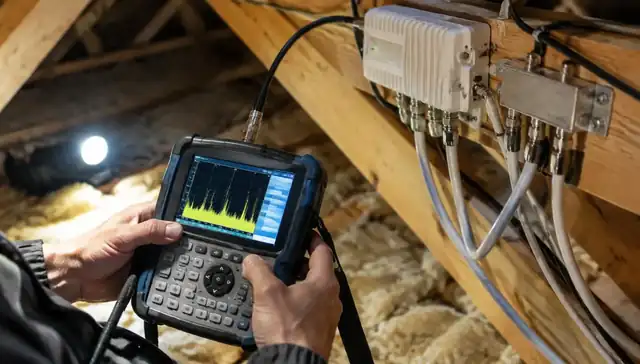
Our meter checks strength alongside MER and BER, showing modulation quality and data errors rather than a single television percentage. We measure the multiplexes independently, as a defect can damage one part of the frequency range while leaving others usable. The result is a picture of the system's performance, not just its loudness.
We compare the aerial feed, powered equipment, splitters and relevant sockets wherever access allows. A step change in quality points to the section between tests. If we cannot reach the source, we make that limitation clear rather than treating a measurement at the lounge as proof that the entire roof installation is healthy.
One flat, one room, or the entire building?
The extent of failure changes the investigation. A lounge that works while the bedroom fails suggests a different starting point from an estate block with several dark screens. We check the television input, flylead and outlet before moving upstream, then compare branches where needed.
Around Dartmouth Park, older houses can combine original room wiring with later conversion work. We inspect terminations for loose conductors, stray screening and improvised connections. A typical job here: two receivers disagree because one branch passes through an extra passive splitter. We measure its actual loss and the incoming margin before deciding whether to alter the distribution or repair a damaged connection.
Check unwanted signals without assuming a mobile mast
A filter should answer a measured problem. We inspect the spectrum, consider amplifier overload and compare the affected multiplexes with appropriate filtering in place. Good local broadcast strength does not rule out interference, but poor reception does not prove a nearby 4G or 5G transmitter is responsible.
We position any required filter before the vulnerable active stage, not merely behind the television because it is convenient. We also examine short patch leads and cable screening. If symptoms coincide with switching a light or using another appliance, controlled checks at accessible switches may be more revealing than filtering the aerial feed. We explain which possibility the results support.
Wind, water and the old external cable
A sound-looking aerial can feed a cable whose jacket has split after years outdoors. Water changes the electrical behaviour and may travel down towards indoor connections. We inspect accessible cable entries, weatherproofing and support, looking for a physical explanation that agrees with the meter rather than blaming rain in general.
Near Parliament Hill Lido, roof height and individual access still need checking property by property. We will not assume that a familiar street makes a chimney safe to reach. If work requires additional access equipment, that becomes part of the agreed plan. Please keep off the roof and do not handle loose external cables yourself.
Communal tests need the right keys and authority
For estate properties, the useful distribution point may be in a locked cupboard rather than inside your home. Let us know who manages it when you book. We can test the domestic side first and identify when the fault appears to lie beyond your boundary, then arrange the next authorised step.
We avoid disturbing unrelated branches and explain any interruption before approved work. A failure at one tap does not automatically condemn the entire headend. We compare like-for-like points where available and state what has been ruled out. This gives the managing agent a defined problem instead of a general complaint that television reception is bad.
Show that the remedy has changed the readings
We repeat the same frequency checks after repairs and test the rooms included in the agreed scope. A replaced connector, corrected gain setting or renewed cable should produce a measurable improvement where it was needed. We also demonstrate normal programmes on your own equipment, because a clean meter at the wall is not the only handover check.
Retuning comes after reception is restored. If duplicate entries or an unsuitable transmitter have complicated the programme list, we deal with those once the feed is reliable. Any continuing limitation, including inaccessible branches or an intermittent symptom not reproduced during attendance, is explained rather than covered up by a quick channel scan.
A straightforward NW5 booking
Call 0800 206 2385 free for advice or WhatsApp 07595 292534 with the error message and your postcode. We are available Mon-Sat 8am-7pm. We arrange same-day attendance where possible, allowing for building access and daylight; on-site work continues only until sunset.
Before the visit, leave accessible equipment connected in its normal arrangement and note which channels fail. We explain the diagnostic arrangements, then give a clear price before work starts and a fixed written quote for any proposed repair. You decide what to authorise; identifying a fault does not commit you to replacing the aerial or rewiring every room.