
We cover N1 homes from Georgian squares to newer apartment developments around Angel. Finchley Aerials has 25 years' experience, and we use that experience to interpret readings in the context of the actual building.
A useful account of the fault saves blind testing
Start with what changes on screen. Does the sound continue while the image breaks up, does a complete channel group disappear, or does the television report the wrong input? We ask whether another room behaves differently and whether the trouble began after a new box, renovation or rearranged furniture.
Near Upper Street, access may involve a shop entrance, a separate stair or a managed residential lobby. Mention those details when booking so the appointment allows for them. We identify the equipment we are authorised to inspect and leave roof cupboards or communal wiring alone until the responsible person has agreed access.
Why a healthy-looking level can conceal errors
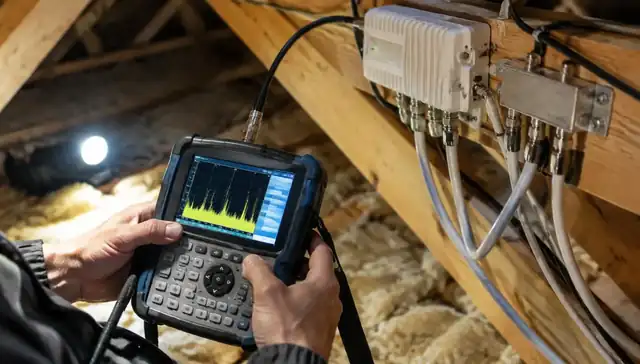
We use a meter to examine each received multiplex, because channels sharing a frequency can fail together. Signal level gives one part of the picture; MER, the modulation error ratio, assesses the cleanliness of the modulation, while BER describes errors in the data. We interpret them together instead of chasing the largest level.
For an Islington apartment, we might obtain a clean reading at the building feed but poor quality after a local amplifier. That comparison identifies where to investigate next. It does not justify blaming the transmitter or fitting a larger aerial. We tell you which measurements support the conclusion and which locations remain untested.
Georgian rooms and later additions to the wiring
Older N1 houses often contain successive cable routes serving rooms that have changed use. We inspect accessible joints, redundant extensions and splitters concealed behind furniture before drawing conclusions about the roof installation. A cable that reaches a socket is not necessarily connected to the aerial you expect.
We agree how to reach each test point without disturbing decorative plaster, joinery or finished floors. Where the route disappears into a sealed void, we explain the testing limit and discuss alternatives rather than opening it without consent. Listed status or conservation restrictions need checking if the eventual remedy changes external equipment or its position.
Testing the interference theory around Angel
We do not diagnose 4G or 5G disruption from a street address. We look at the spectrum around the television frequencies and assess how the distribution equipment handles unwanted signals. Overload can affect an amplifier before the television receives anything, making the picture fail despite apparently plentiful strength.
A suitable filter is a testable remedy, not a default addition. We compare reception before and after filtering and locate it ahead of the component that needs protection. If errors persist, we examine poorly screened leads, power supplies and other possible interference sources. Nearby mobile coverage alone is not enough evidence to sell you a filter.
Buildings can obstruct as well as reflect
Tall neighbouring buildings make aerial position relevant even where the wider district receives Crystal Palace well. We assess the incoming quality at the available aerial position and compare frequency groups. Raising gain cannot restore information already lost through an unsuitable reception path, and simply copying the neighbouring roof may reproduce its compromises.
Where a different receiving position merits investigation, we describe the access and permission requirements first. We can consider another transmitter only with its service selection explained. Choosing a relay may change which channels are available, so a neat signal reading must be considered alongside what you actually want to watch.
Separating your outlet from the shared installation
Modern apartment blocks near Highbury Fields can distribute a common feed through equipment outside individual flats. We check the accessible outlet and receiver lead before requesting communal access. A failing outlet and a headend fault have different repair scopes, ownership and approval routes.
We never disconnect a live communal branch without establishing its purpose and obtaining permission. If the managing agent needs to arrange an authorised system visit, we explain our measurements and the next test required. Where the problem is inside your own flat, we quote for that specific repair and avoid expanding it into work on serviceable shared infrastructure.
Verify the repair across the affected programme groups
A picture returning for a minute does not complete the diagnosis. We repeat measurements at the relevant stages, confirm the channels that failed and check the agreed receivers in their usual configuration. We leave working splitters or amplification in place when their performance is satisfactory.
If the fault only appears at particular times, we use your log to plan the next observation. You can record which channel, when it happened and whether household equipment was operating. We do not claim a power supply, cable or interference source is responsible unless testing supports it. Unresolved uncertainty belongs in the findings, not hidden behind a confident guess.
Book the tests with access already considered
Our office is on Britannia Road, Finchley N12 9RU, and we travel to Islington for signal investigations. Free advice is available on 0800 206 2385; WhatsApp messages can go to 07595 292534. Contact hours are Mon-Sat 8am-7pm, with outside work limited by safe daylight and on-site work finishing by sunset.
We offer same-day service where possible and confirm the visit arrangements when you call. Give us your postcode, building type and known symptoms. We provide a clear price before work starts and a fixed written quote for the proposed repair, with any further access requirements made explicit.