
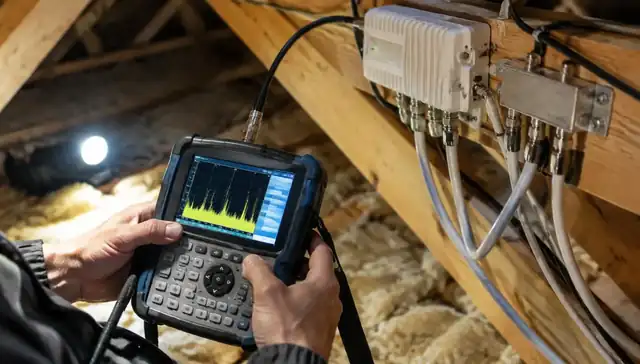
N22 mixes Victorian terraces and conversions with newer apartment buildings around the High Road. A fault can start outside the property, in a shared cupboard or behind your own screen. We work through those possibilities in a sensible order, keeping you informed about what the evidence actually shows.
Start at the screen, not automatically on the roof
We ask which input you watch and whether the problem affects broadcast television, a satellite receiver or an internet app. An aerial repair will not solve an app buffering over Wi-Fi. Checking the source, error message and connected equipment lets us keep the investigation on the correct system from the outset.
For an aerial-fed television, we examine the flylead and socket and compare the feed with our meter. If another set works, that is useful evidence, but only when we know which outlet and distribution branch it uses. We avoid declaring a receiver faulty until the signal arriving at it has been checked.
Wood Green reception support →Our approach to fault finding →
Reflections around the High Road need careful measurement
Wood Green generally has good terrestrial reception, but tall buildings near the centre can alter the paths by which a signal reaches an aerial. Reflected signals may contribute to intermittent breakup even when the strength indication looks healthy. We assess quality and position rather than responding with a more powerful amplifier.
A typical job here: a terrace beside newer development has plenty of measured level but unstable reception on several channel groups. We compare alignment and available aerial positions, looking for better quality rather than the highest strength figure. We only recommend moving equipment when the comparison supports it and the mounting arrangements are suitable.
Find out whether the whole building is affected
In an apartment block near Wood Green High Road, ask whether neighbours have lost the same services. That helps define the investigation, although it does not replace testing. We compare the flat's outlet with authorised accessible distribution points to distinguish an individual cable problem from a shared feed failure.
We need permission before altering communal equipment, plus access to the relevant cupboards or risers. Please give the managing agent our details if they control the system. We will explain any access gap in the findings; testing one flat cannot prove the condition of every branch throughout the building.
Compare the channel groups along each branch
Our readings include signal level, MER and BER. MER helps assess the quality of the received modulation; BER indicates data errors at the measurement stages available. We compare multiplexes, the broadcast groups carrying different channels, rather than testing one programme and assuming the rest must be satisfactory.
In converted houses towards Bounds Green, additional outlets may have been connected through successive splitters. We measure before and after accessible components to locate the change. A loose connector, inadequate screening or excessive branch loss can then be investigated directly. We retain equipment that performs correctly instead of treating every old component as defective.
Separate interference from an amplifier problem
A booster can be part of the fault when its gain overloads the next stage or its power supply becomes unreliable. We compare its input and output and check the supply arrangement. Bypassing it is only a useful test when the receiving equipment and the rest of the installation allow that comparison safely.
We use spectrum information when investigating unwanted signals, including possible mobile interference. Where justified, a suitable filter comparison helps establish the effect. Breakup linked to a lamp or plug-in supply needs a different enquiry. Tell us about repeatable timing, but do not dismantle electrical equipment to hunt for the source yourself.
Alexandra Palace nearby does not settle transmitter choice
Being near Alexandra Palace does not tell us which transmitter your installation should use. We assess the available reception, including Crystal Palace, and check the services expected from the chosen source. The Alexandra Palace relay offers a smaller channel selection, which we explain before considering any change of alignment.
We also check whether an HD complaint involves the receiver's capabilities or stored tuning rather than a damaged aerial. Repeated scans during a reception outage can leave fewer channels in memory. Once the incoming feed is dependable, we address tuning and demonstrate the available services instead of using retuning as a substitute for diagnosis.
Crystal Palace information →Crouch End reception diagnosis →
Know what was found and what happens next
We outline the fault location, the recommended repair and any limits to the tests. You receive a fixed written quote before repair work proceeds. If the interruption does not occur during our visit, we report the checks honestly and suggest a focused fault log or further access, rather than announcing an unproven cure.
Call Finchley Aerials and Satellites on 0800 206 2385, free, or WhatsApp 07595 292534 with your postcode and symptoms. We have 25 years' experience, based at Britannia Road, Finchley N12 9RU. We take enquiries Mon-Sat 8am-7pm, with on-site work until sunset. Free advice is available; same-day visits are offered where scheduling allows, and diagnostic charges are agreed beforehand.