
Crystal Palace reception is generally good here. That makes it especially important to check what happens between the aerial and your receiver before ordering a new aerial. Around Bruce Castle, Tottenham Hale and the estates between them, we investigate missing channel groups, intermittent pictures and complete losses of reception.
First establish who has lost reception
In a block, ask whether a neighbour has the same problem, without unplugging anything in a shared cupboard. Several affected flats suggest a different starting point from one silent bedroom socket. Tell us whether the failure began together and whether every channel is involved. We use that information to plan the tests, not as proof of the cause.
For a Victorian terrace split into flats, the arrangement may be less obvious: one roof aerial can serve several separate cable routes. We identify your feed and the equipment we have permission to inspect. A television showing a menu but no broadcast picture tells us the screen works; it does not establish that its tuner or incoming feed is sound.
Read the broadcast, not just the strength bar
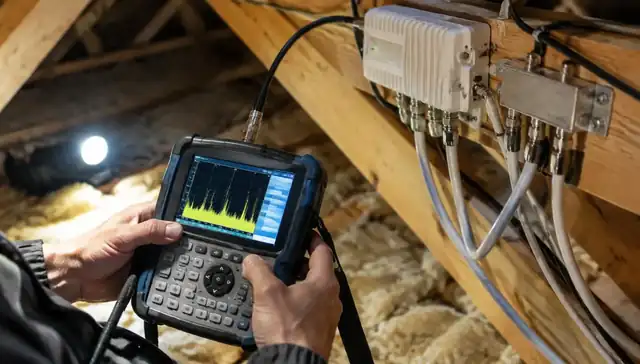
We measure signal level and the quality of the data at the outlet. Modulation error ratio, MER, helps assess how clean the signal is; bit error rate, BER, shows errors at the stages our instrument supports. A high strength display can sit alongside poor reception when distortion or overload is present.
We check the received multiplexes separately because each carries a group of services. Losing several channels together can point towards one affected frequency, rather than several broken broadcasters. Comparing those readings at accessible upstream points helps distinguish a poor incoming signal from deterioration inside the distribution. We explain the findings without expecting you to interpret a meter screen.
Older distribution deserves a proper comparison
Some Tottenham estates depend on ageing communal equipment. We compare amplifier input and output, check its power supply and inspect the relevant splitter branch where access is authorised. An amplifier can pass some frequencies poorly or introduce distortion; replacing the aerial above it would leave that fault untouched.
A typical job here: one flat near Tottenham Hale loses a channel group while the neighbouring outlet remains usable. We compare the feeds, then test the suspect wall plate, flylead and branch connection. The result may justify a small repair, or it may show that the managing agent needs a wider distribution investigation. We keep those responsibilities clear.
Make an intermittent failure useful evidence
Keep the channel name, approximate time and weather when the picture fails. Note whether sound breaks up too and whether another room stays clear. A short record is more useful than repeatedly retuning, which can remove stored services while the signal is absent. Photographs of an error message are welcome.
Where wind or rain appears relevant, we inspect accessible exterior coax, connections and cable support. Moisture entering a damaged sheath can travel beyond the visibly wet joint. We do not claim a weather-related diagnosis just because a connection looks old. If the fault stays absent during testing, we record the available evidence and discuss monitoring or a further visit.
Repairing identified aerial defects →Arrange diagnostic access →
Check interference before fitting a filter
Mobile interference is one possibility, not the default explanation for every blocky picture. We examine the spectrum and compare reception with suitable filtering when the measurements justify that test. A useful filter belongs before the equipment being overloaded, rather than at an arbitrary point behind the TV.
We also consider local electrical noise. If the failure coincides with a light or plug-in supply, we can observe readings while you operate its normal controls. We never ask you to open electrical fittings. Equally, adding a booster without measuring the feed can make strong-signal overload worse instead of recovering missing channels.
Mobile signal interference checks →Freeview reception help →
Separate satellite trouble from terrestrial reception
Tell us whether the affected service comes through an aerial or dish. For satellite systems we investigate the receiver supply to the LNB, connectors and the relevant dish feeds. Different receivers need compatible feed arrangements, so the equipment model matters when one box works and its replacement does not.
We assess obstruction and alignment where safe access allows, rather than moving the dish as an experiment. A sound feed at the dish and a poor result indoors shifts attention to the cable path. We agree the scope before touching shared satellite equipment and explain any access limitation that prevents a complete test.
Tottenham satellite assistance →Nearby Wood Green diagnostics →
Access, findings and an agreed repair
For estates and new apartment schemes, arrange keys and managing-agent approval for locked equipment rooms in advance. Near Tottenham Hotspur Stadium, tell us about access or parking restrictions affecting your booking. We also need to know about high ceilings, concealed sockets and any roof work that might require specialist access.
We set out what we measured, where quality changes and what remains untested. You receive a clear price before work starts on the proposed repair. Once authorised work is complete, we repeat the relevant checks at the affected outlet, rather than treating a brief return of the picture as sufficient evidence.
Speak to us with your postcode and symptoms
Finchley Aerials and Satellites brings 25 years' experience from our base on Britannia Road, Finchley N12 9RU. Call free on 0800 206 2385 or send WhatsApp details to 07595 292534. Free advice can help establish what information and access we need before travelling.
Our telephone hours are Mon-Sat, 8am-7pm; on-site work runs until sunset. Same-day attendance is possible when the diary and access permit. Tell us the number of affected rooms and whether you rent or control the shared system, so we can arrange a visit with a useful, realistic scope.