
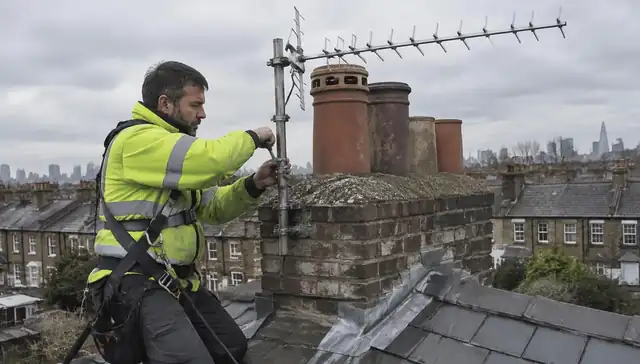
From Victorian terraces near Bruce Castle to estates and newer buildings around Tottenham Hale, there is no single wiring layout to assume. We check what serves your property and who controls it. Good Crystal Palace coverage across Tottenham does not prevent an ageing connector or communal amplifier from interrupting your viewing.
Collect a few clues before changing anything
Write down which channels have disappeared and whether they fail on every set. Ask a neighbour about their reception if you share an aerial, but leave communal cabinets alone. That small comparison can help distinguish a building fault from a damaged lead in your lounge, without anyone disturbing the system.
Check that the television is on its broadcast input rather than an unused HDMI connection. If convenient, try a removable aerial lead known to work. Avoid repeatedly scanning for channels during an outage: the television may simply replace its saved list with a shorter one while the physical fault remains.
Communal repairs need the right access, not another booster
An estate aerial can feed many homes through several distribution stages. We need to establish where a clean signal becomes a poor one, which may require access outside your flat. Please involve the landlord, housing provider or managing agent so they can authorise checks on equipment they control.
We test incoming reception, power arrangements and relevant outputs rather than turning up a gain control until the meter looks stronger. A failed supply or an unequal branch can affect a whole section of a building. Where equipment needs renewal, we explain compatibility and the scope instead of assuming every resident needs a new aerial.
Terrace wiring can hide the weak connection
In a Victorian terrace, the original downlead may now pass through additions made for bedrooms or a rear extension. We follow accessible cable routes and identify splitters, wall plates and amplifiers before deciding where to intervene. A tidy-looking socket does not reveal the condition of the joint feeding it.
A typical job here: the front room receives everything while an upstairs set loses a group of channels. We compare both branches, bypass a suspect connection for testing and establish the loss. If that branch is responsible, we repair it and leave the functioning roof equipment alone. The example describes a method, not an assumed diagnosis.
HD reception needs a capable receiver and a clean feed
Missing HD services sometimes prompts requests for an 'HD aerial'. We first check whether the television supports the required broadcast standard and whether the relevant multiplex reaches its socket cleanly. An aerial receives radio frequencies; a label on its packaging does not establish the condition of the complete installation.
Our readings cover signal level, modulation quality and errors across channel groups. Older communal components or poor connections can affect some frequencies more than others. We distinguish those losses from receiver limitations, then recommend repairs or suitable equipment only where the tests demonstrate a need.
Outdoor faults: secure the cause as well as the cable
If your picture changes with wind, we look for movement in the mounting or cable and inspect accessible supports. If rain triggers the fault, we examine weatherproofing and cable condition. Neither symptom proves that the aerial elements themselves are defective; damage further down the feed can produce similar viewing problems.
Where we renew an exposed run, we plan secure fixing and properly protected connections. A shifted mast needs its supporting hardware assessed before alignment. We cannot attach equipment to unsafe masonry, and we discuss any additional access requirements rather than taking risks over an extension or awkward roofline.
Arrange outdoor fault checks →Nearby Palmers Green repairs →
Changing surroundings do not justify guesswork
The mix of established housing and regeneration around Tottenham Hale makes it important to measure reception at the actual address. We do not blame a nearby development simply because it is visible from the window. Obstruction, reflections and equipment faults need separating before any recommendation to move an aerial.
Mobile signals can also affect unsuitable or poorly screened installations. Where our tests suggest interference, we assess a suitable filter in the correct part of the feed. Adding filtering indiscriminately is not our approach: it will not restore a broken conductor or compensate for water inside a downlead.
Plan the appointment around real building access
Near Tottenham Hotspur Stadium, tell us if your appointment coincides with event-related access restrictions. Elsewhere, let us know about parking controls, locked gates and shared roof entrances. For a block, an appointment is more useful when the authorised person can open the necessary service areas.
We outline any diagnostic charge in advance and provide a fixed written quote for the repair we recommend. After approval and completion, we repeat the tests and check viewing at the agreed outlets. If tuning needs attention, we do that on a restored signal and explain what was changed.
Call us before buying replacement equipment
Our free number is 0800 206 2385; WhatsApp is 07595 292534. Send the N17 address, a brief symptom description and whether the feed is shared. We answer Mon-Sat, 8am-7pm, and offer same-day service where possible. Outdoor work continues only while daylight and conditions allow, up to sunset.
Finchley Aerials and Satellites has 25 years' experience and is based on Britannia Road, Finchley N12 9RU. We give free advice and explain likely next steps without asking you to buy parts on speculation. Keep any safe indoor photographs of outlets available, but do not climb to inspect the aerial.