
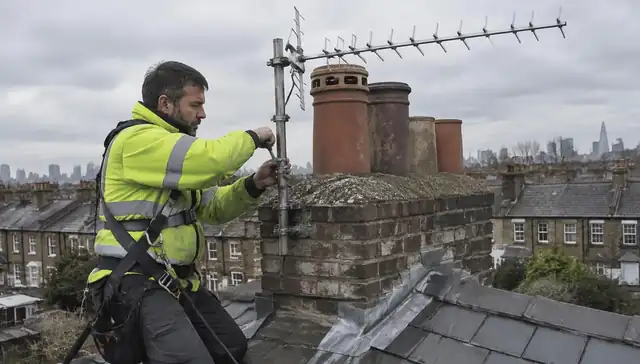
Wood Green combines Victorian terraces and conversions with newer apartment blocks near the High Road. Local reception is generally good, but tall buildings can complicate the signal path. We do not assume that every fault needs a higher aerial: an indoor connection, distribution stage or weathered cable can be the more useful place to look.
Intermittent faults leave useful clues
Does the breakup happen on one channel group, in one room, or throughout the property? Does it coincide with wind or rain? A note of those details helps us choose the testing sequence. If possible, photograph the on-screen message rather than retuning away the evidence or repeatedly resetting the television.
We begin with accessible checks at the viewing point, including the flylead and selected input. Then we measure the socket and compare it with upstream points. A fault need not be visibly happening throughout the visit for marginal quality, excessive losses or an unreliable connection to show up in the checks.
Near the High Road, test reflections before moving equipment
A new tall building can alter the route by which broadcast signals reach an aerial, but its presence alone is not a diagnosis. We inspect the existing installation and assess reception quality at your property. The answer may be a positioning adjustment, or the measurements may reveal an unrelated cable fault.
We look beyond strength to the integrity of the digital signal. Reflected signals, interference and overload can produce a poor picture despite a healthy-looking strength bar. Repositioning is recommended only when the evidence supports it, with the proposed fixing and cable route discussed before alterations begin.
Alexandra Palace nearby does not settle the transmitter choice
Being close to Alexandra Palace does not mean its relay is automatically the right source for every home. We assess the existing reception arrangement and available alternatives where relevant. A relay can carry a smaller service selection, so changing direction without discussing the channel implications can create a different disappointment.
Our aim is a stable, appropriate feed for the services available at your address. We compare broadcast groups, check alignment where necessary and explain any limitations. We will not promise that changing the aerial can deliver a service absent from the chosen transmitter or unsupported by your television.
Conversions need their wiring understood first
A converted terrace can contain several disconnected generations of aerial wiring. The cable beside your window may not serve your flat, and a powered unit in a cupboard may supply more than one household. We identify the relevant feed before removing or replacing anything, asking about ownership where routes are shared.
If other residents have matching symptoms, we involve the landlord or managing agent for communal access. Where only your outlet is affected, we test that branch and its connections. Keeping the investigation specific helps avoid disturbance to neighbours and prevents a working shared installation from being altered unnecessarily.
Repair the weather entry point, not just its aftermath
Outdoor coax can split after prolonged exposure or rub where it has come loose. Moisture entering above a joint may eventually reach equipment indoors. We inspect the accessible cable path and explain the extent of damage before proposing a local connection repair or renewal of a longer run.
For replacement cabling, we agree suitable fixing positions and a sensible entry route. We protect external connections and leave the run supported rather than hanging under its own weight. If the aerial moves in wind, its bracket and mast need checking as well as its alignment; unsafe supports cannot be corrected by retuning.
Boosters and filters have particular jobs
An amplifier can compensate for suitable distribution losses, but it cannot reconstruct damaged broadcast data. We test the incoming feed, power supply and outputs before deciding whether an existing booster should stay. Multiple amplifier stages can introduce overload, so more equipment is not necessarily an improvement.
Likewise, filtering is useful when unwanted mobile frequencies are affecting reception, not as a general cure for every missing channel. We test for the relevant interference and examine screening. If a filter is justified, its location matters: it needs to protect the susceptible equipment rather than sit after the damage has already occurred.
Mobile signal interference advice →Nearby Tottenham support →
Your approval comes before the repair
We explain the test findings in ordinary language and provide the recommended scope with a fixed written quote. Booking arrangements include an explanation of any chargeable diagnosis. If the investigation uncovers something beyond the agreed repair, we pause to discuss it rather than treating your original approval as open-ended.
Completion includes repeat readings and a viewing check at the outlets covered by the job. We retune only where needed after the feed is restored. Please mention inaccessible televisions or rooms beforehand so we can agree how they will be checked and make any remaining limitations clear.
Getting help in N22
Call 0800 206 2385 at no charge, or WhatsApp 07595 292534 with your address and reception symptoms. Mention controlled parking, rear access and any keys needed for communal areas. We answer Monday to Saturday, 8am-7pm, with same-day service offered when possible and site work continuing until sunset where conditions permit.
Our business is Finchley Aerials and Satellites, based at Britannia Road, Finchley N12 9RU. We have 25 years' experience and offer free advice before you commit to replacement equipment. Please do not get onto a roof to gather information; an indoor socket photograph or a ground-level view is sufficient for an initial discussion.