
Around the Clock Tower, towards Hornsey and beside Parkland Walk, Victorian houses and converted flats bring different access and wiring questions. We work out how your system is arranged, measure where quality is lost and explain the smallest justified repair. You remain in control of what happens next.
The slope is a clue, not the whole explanation
A property lower in the local bowl may have a less favourable path towards the transmitter than one higher up. We assess the actual feed before attributing the problem to terrain. A deteriorated connection can produce symptoms much like marginal reception, and fitting a longer pole would leave that defect untouched.
When the incoming broadcast is the limiting factor, we compare feasible positions and alignment where access is safe. Crystal Palace is considered against the site conditions. The Alexandra Palace relay may offer an alternative at some properties, but its smaller service selection must be explained before any change is recommended.
What we ask before the visit
Please tell us whether the fault affects every programme, a particular group or just one television. Note the displayed message and whether the issue follows wind, rainfall or an appliance being used. We also ask about recent alterations, because a moved socket or disconnected supply can change an otherwise working installation.
For a converted house, explain which parts are private and whether the aerial serves other flats. We agree the testing boundary and access arrangements beforehand. If the route passes through another resident's loft or a locked shared space, we need permission rather than assuming your appointment covers access throughout the building.
Measure enough to distinguish weak from damaged
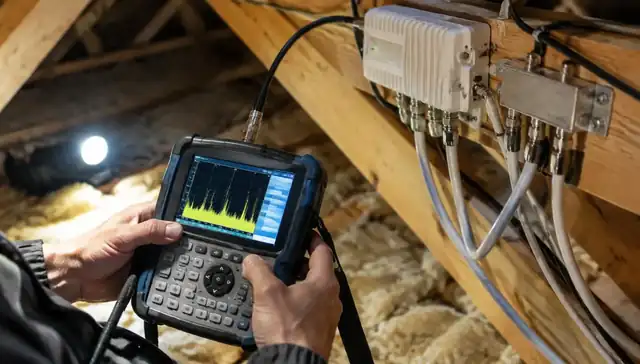
Signal strength alone can be misleading. We use level readings alongside modulation error ratio and bit error rate to assess how well the digital broadcast survives. A strong signal with poor quality requires a different response from a clean feed reduced by distribution losses. We explain the distinction without expecting you to interpret meter jargon.
We compare multiplexes, the groups carrying the channels, at relevant points along the installation. A defect may damage one group while leaving another watchable. This is why we do not declare the aerial healthy after checking a single station, or condemn a television because its own strength indicator looks high.
Follow the route through a Victorian conversion
Older houses can contain cables from several stages of alteration. We identify the feed in use, inspect accessible terminations and compare the signal before and after splitters. Hidden wiring is not automatically defective; we seek a measurable change before proposing disturbance to decorated rooms or replacement of a lengthy run.
A typical job here: one flat has broken HD pictures while another remains clear. We compare the affected branch with the common feed and test the outlet and flylead separately. If the deterioration begins at a termination, that gives us a specific repair to quote instead of recommending a new aerial for everyone.
Movement, moisture and faults that vanish
A windy-day failure near Parkland Walk warrants attention to the mounting, exposed cable and joints as well as alignment. We examine accessible parts for movement or deterioration, with roof access assessed separately. Rain-linked trouble may involve water entering a connection or damaged sheath, not simply weather affecting the broadcast.
Sometimes the picture remains perfect throughout a visit. We use your fault notes and the measured reception margin, record what can be established and acknowledge what cannot. We will not label an intermittent component as definitely failed without supporting evidence. Further observation or a targeted return may be more useful than speculative replacements.
Discuss a recurring symptom →Muswell Hill diagnostic visits →
Check gain and interference together
An amplifier may compensate for measured cable and splitter losses, but it cannot turn a corrupted input into a clean broadcast. We examine its input, output and supply. Excessive gain can overload equipment, so increasing the setting without measurements may worsen the very breakup you are trying to cure.
We inspect the spectrum when unwanted signals are suspected and compare the effect of appropriate filtering if justified. We also consider household electrical interference. You can help by noting whether the problem coincides with ordinary lighting or appliance controls; leave electrical covers and powered equipment unopened for safety.
Understanding 4G and 5G interference →Archway fault finding →
A clear conclusion, with any limits stated
We describe the point where reception deteriorates and the work justified by that finding. If a replacement cable is required, we agree its route before drilling. Where a building has protected status or restrictions on external alterations, we flag the relevant permission checks rather than assuming a visible fixing is acceptable.
After an authorised repair, we check the affected channel groups and agreed rooms again. Retuning comes only when the feed is usable and a scan is needed. If you receive satellite services as well, we investigate those connections separately; terrestrial measurements cannot establish that a dish feed is working correctly.
Talk through the problem with us
Finchley Aerials and Satellites has 25 years' experience and is based at Britannia Road, Finchley N12 9RU. Call free on 0800 206 2385 or WhatsApp 07595 292534 for advice. A postcode and short description are useful; please include any entry or parking constraints when requesting a visit.
We take calls Mon-Sat between 8am and 7pm and arrange same-day help when possible. On-site outdoor tasks finish by sunset. We explain the visit terms and provide a clear price before work starts on repairs, so diagnosis does not become permission for an unagreed replacement installation.