
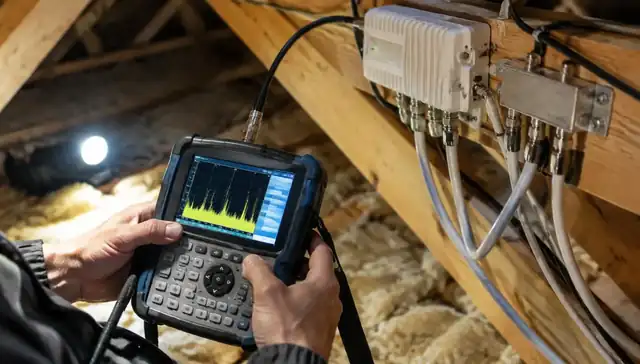
The difference between a roof above The Green and a property lower in the valley matters here. So does the cable between that roof and your screen. We check both sides of the problem before recommending extra height, new equipment or a repair to something you already own.
The hill helps some houses, not every installation
Many higher roofs have a useful path towards Crystal Palace. Lower positions can have less reception margin, but that does not mean every valley-side semi needs a taller mast. We assess the actual signal and mounting position. Turning up amplifier gain cannot recover broadcast information that the aerial has failed to receive cleanly.
Around Grange Park and towards Grovelands Park, we consider nearby rooflines and trees alongside the existing aerial position. We discuss any proposed external change before proceeding. Where a cottage has protected status or other restrictions, the necessary consent checks come before alterations, not after a new bracket is fixed.
Keep a record of the weather and the symptom
Tell us whether rain starts the problem immediately or reception deteriorates later. Wind-related interruptions can suggest movement at a connection or mounting, while moisture may enter a damaged cable and take longer to show itself. These are starting clues; we still need measurements and a physical inspection to establish the cause.
Use channel names rather than just saying the usual programmes have gone. Note the duration and whether another room stays watchable. Please leave climbing, roof inspection and external cable handling to us. A photograph taken safely from ground level is more useful than risking a ladder to inspect a connection.
Follow quality from the aerial to the viewing chair
We measure broadcast level and quality, including MER and BER: indicators of modulation quality and data errors. The television's strength display cannot tell the whole story. We compare channel groups and trace any deterioration through accessible amplifiers, splitters, wall outlets and the final lead into your receiver.
In an Edwardian villa with several added TV points, the original feed may be sound while an extended branch loses too much signal. In an inter-war semi, an old loft splitter may be the weak link. We explain which points we have tested and which remain inaccessible, so the diagnosis has a clear, honest scope.
Decide whether amplification earns its place
A distribution amplifier can compensate for measured losses when one aerial supplies several rooms. It cannot straighten a bent connector or dry out waterlogged coax. We check its input, output and power supply before recommending replacement. Too much gain can overload equipment and make a supposedly stronger signal less reliable.
We also investigate interference when the readings or timing suggest it. That can mean examining the spectrum and comparing results with suitable mobile-signal filtering. It can also mean checking whether an accessible household device coincides with the disruption. We never identify 4G or 5G as the culprit merely because a mast is visible.
When the fault is on a satellite feed
If your receiver uses a dish, tell us the make and model when booking. We check the relevant feed arrangement, connector condition, LNB supply and measured reception. A displaced dish, failed LNB and damaged indoor lead need different responses. We confirm compatibility before suggesting parts for Sky Q or a Freesat recorder.
A typical job here: an N21 house has reliable terrestrial television but one satellite receiver loses reception after rain. We test that satellite path rather than adjusting the unrelated aerial. If outside access is necessary, we assess the mounting and safe working position before agreeing how to reach the equipment.
Agree the repair, then prove the improvement
We describe the evidence and offer a fixed written quote for the recommended repair. Sound aerials, cable sections and receivers stay in service where suitable. Cable renewal includes an agreed route, not an unexpected line across the front of a cottage. Any specialist access requirement is discussed as part of the proposed work.
Afterwards we revisit the affected readings and watch the relevant services with you. If the symptom cannot be reproduced, we separate verified findings from possibilities and agree what to monitor. We do not promise that a short dry-weather test proves every wet-weather interruption has disappeared. The handover explains what was established.
Repairs for existing aerials →Our Enfield borough coverage →
Plan a visit with the right access
For flats, we ask who can authorise work on shared equipment and open any distribution cupboard. For houses, mention restricted side passages, roof access and parking arrangements when you call. Advance information helps us plan the testing without assuming a ladder can be placed wherever the fault happens to be.
You can reach Finchley Aerials and Satellites free on 0800 206 2385 or through WhatsApp 07595 292534. Our base is Britannia Road, Finchley N12 9RU, and we bring 25 years' experience. Contact hours are Mon-Sat, 8am-7pm; outdoor visits continue until sunset. We provide free advice and try for same-day service when possible, with visit terms explained before booking.