
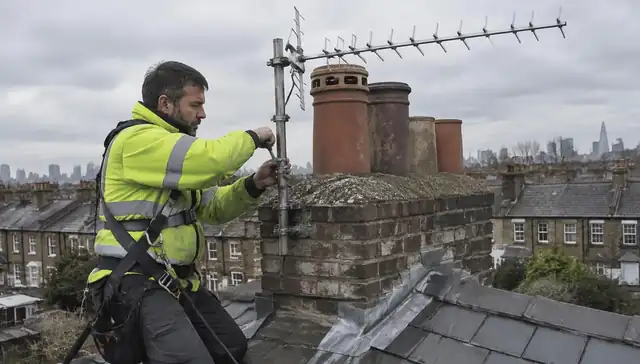
N21 includes Victorian cottages around The Green, Edwardian villas and inter-war semis. Roof heights and ground levels vary, so we do not prescribe the same aerial arrangement for every address. We assess the existing equipment and keep what remains safe and effective.
The hill and the valley need different assessments
Higher roofs can enjoy a clearer path towards Crystal Palace, while lower properties may need more careful positioning or additional mast height. That is a reason to measure at the actual property, not a reason to sell every household a tall pole. We compare the available quality and the condition of the present installation.
Around Grovelands Park and Grange Park, individual rooflines and nearby obstructions still matter. A neighbour's successful alignment is useful context but not a specification. If a change of position is justified, we explain why and check what the supporting structure can safely accommodate before proposing a mounting solution.
Wind-related breakup starts with a stability check
A loose bracket can allow enough movement to interrupt reception even when the aerial looks roughly aligned from the pavement. We inspect mast security, fixings and cable movement, looking for evidence of wear rather than simply turning the aerial until a picture appears. Alignment needs to remain stable after we leave.
A typical job here: at an inter-war semi, reception breaks up when the mast moves in gusts. We inspect the support, agree any necessary bracket repair and realign using measured signal quality. We then compare the indoor reading, because securing the roof equipment does not rule out damage further along the cable.
Chimneys and older cottages deserve a careful approach
On cottages near Winchmore Hill Green, a compact frontage can make the roof equipment look straightforward while access is anything but. We ask about side paths, rear extensions and shared boundaries before planning outdoor work. We also inspect the masonry rather than assuming an old chimney can support a new load.
If building repairs are needed, we explain that limitation before attaching aerial equipment. Any permissions associated with conservation controls, listed status or shared ownership must be addressed before external alterations. We aim to retain sound fixings where appropriate, but age and appearance alone do not establish whether a mounting is safe.
Wet coax can mimic poor coverage
A cracked cable jacket or an unprotected joint can admit rain and reduce signal quality. If reception worsens after a downpour, tell us how quickly it recovers and whether every room is affected. Those clues help us decide which part of the route deserves inspection first, even on a dry visiting day.
We trace the affected cable and quote for the length that needs renewal. Replacement screened coax is clipped securely, kept clear of sharp edges and protected at outdoor connections. We agree the entry point with you and check for water tracking indoors. A repair should address the route of entry, not merely replace a visibly corroded plug.
One bad room does not prove a roof fault
Extensions and additional bedrooms may have feeds added long after the original aerial was installed. We compare the incoming cable with the affected socket, testing splitters, wall plates and removable leads along the way. If the signal is healthy before a branch and poor after it, that branch becomes the focus.
We check amplifier power and gain where distribution uses powered equipment. More amplification is not automatically better: overload can cause digital breakup too. Any recommendation for filtering follows evidence of interference, rather than a guess based on nearby mobile equipment. We explain which component failed and which parts can remain in service.
Channel groups give useful diagnostic clues
Several missing stations may share one broadcast multiplex. We compare reception across the groups instead of testing only a favourite channel that happens to work. Signal quality and error measurements help distinguish marginal reception from a connection problem or unsuitable distribution equipment.
We normally assess Crystal Palace first. If an alternative such as the Alexandra Palace relay is relevant, we discuss its smaller channel selection before making an alignment decision. We also establish whether your television can decode the HD services you expect. A receiver limitation cannot be repaired by moving the aerial or fitting a stronger amplifier.
Agree the scope, then check the outcome
After investigating, we set out the recommended work in a fixed written quote. That includes the parts and cable route involved, with any access limitations made clear. If further damage becomes apparent during the agreed repair, we pause to discuss it rather than silently extending the work.
At completion we repeat the relevant measurements and demonstrate the restored services. A retune, if needed, comes after the reception is usable. We check the outlets included in your booking and explain any that remain outside the scope. You can ask us to talk through the result without having to interpret meter terminology yourself.
Arrange an N21 visit with useful information ready
Contact us on 0800 206 2385, free to call, or WhatsApp 07595 292534. Include your postcode, the affected rooms and any weather pattern you have noticed. We offer free advice and try to arrange same-day assistance where our schedule, permissions and safe access make it practical.
Finchley Aerials and Satellites is based at Britannia Road, Finchley N12 9RU, with 25 years' experience. We answer enquiries Mon-Sat from 8am until 7pm. Roof work relies on suitable conditions and available daylight, with on-site work finishing by sunset. Please mention access restrictions when we discuss the appointment.