
Our diagnostic work is about finding the point of failure before buying parts. We bring 25 years' experience, compare the signal at successive stages and explain what the results justify. You receive a clear price before work starts and a fixed written quote for the repair we recommend.
One postcode, different starting conditions
Victorian villas, inter-war semis and newer developments around Barnet do not all present the same cable route. A house near the higher ground may receive a healthy aerial feed yet lose quality through an old extension lead. Lower positions around New Barnet can need a closer examination of alignment and reception margin.
We use local geography as a reason to investigate, not as a diagnosis. References such as Barnet Market, High Barnet or the direction towards Hadley Wood help us plan the visit. They cannot tell us whether your amplifier has failed. We need measurements from the equipment serving your home before making that decision.
Tell us how the failure behaves
Does every channel vanish together, or does one group break into blocks while the others stay clear? Does the fault affect a recording as well as live viewing? We ask these questions because the answers separate reception trouble from receiver, connection and programme-guide issues.
A simple written log is particularly useful for occasional failures. Include the time, weather, room and channel rather than repeatedly resetting the television. If you have changed a lead or moved an amplifier, tell us what changed and when. We preserve that information during testing instead of erasing it with a channel scan at the outset.
The measurements that guide our decisions
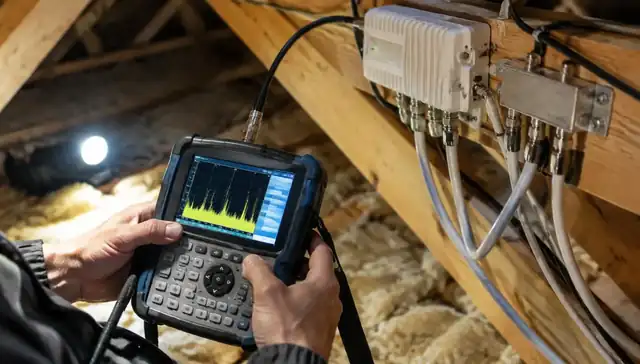
We check signal level together with MER and BER. Modulation error ratio describes the cleanliness of the received modulation; bit error rate shows errors in the data at the stages our meter supports. These measurements help explain why a television can report strong reception while still producing a broken picture.
We compare the available multiplexes rather than accepting one working station as proof of a healthy system. Marginal reception can leave some frequency groups usable and others unreliable. We record the test location alongside the result so that readings from the aerial feed, distribution unit and room socket form a meaningful comparison.
From loft distribution to the last outlet
Many semis distribute one aerial to several rooms. We identify the input, splitter or amplifier, its power supply and the separate branches before removing anything. A loss common to all branches sends us upstream; a fault confined to one bedroom sends us towards that outlet and its cable.
Accessible loft connections deserve the same attention as the roof. We look for insecure plugs, damaged screening and cables crushed by stored items or later building work. When a run needs replacement, we agree the route and specify suitable screened coax. We retain sound sections where practical rather than assuming every old-looking cable must go.
Amplifiers and possible 4G/5G overload
More amplification is not automatically beneficial on the High Barnet ridge. We measure the input and output and check whether excessive gain is pushing equipment outside a useful operating range. A failing power supply can also make several rooms appear to have unrelated television faults.
For suspected mobile interference, we inspect the spectrum and compare reception with appropriate filtering. A nearby mobile installation does not establish causation. Where tests support a filter, we locate it before the susceptible amplifier or other overloaded stage. We then remeasure television signals to confirm the change helps rather than merely adding another component to the cable.
When weather is part of the evidence
Wet-weather breakup can arise from water entering an exterior joint or damaged cable jacket. Wind-related trouble can involve moving fixings or a loose termination. We inspect accessible physical components and compare their condition with the fault pattern, arranging safe roof access separately where necessary.
If conditions are dry and the fault will not reproduce, we say so. We can still identify damage or inadequate reception margin, but those findings need to be distinguished from a confirmed cause. We agree a sensible next step, which may involve monitoring, further access or checking the system when the symptoms return.
An agreed repair, then a repeat test
A typical job here: a New Barnet semi has a stable lounge picture while upstairs HD services drop out. We test the distribution branches and amplifier supply, looking for the measurable change rather than ordering another aerial. Once the fault is established, we explain the repair and seek approval.
The same test points matter after the work. We check level and quality again, reconnect the customer's equipment and confirm reception at the outlets covered by the visit. If tuning needs correcting, we do that once the feed is reliable. You hear what was changed and what evidence supports the result.
Booking a Barnet diagnostic appointment
We take calls Monday to Saturday between 8am and 7pm on 0800 206 2385, free to call. WhatsApp 07595 292534 if a photograph of the message or equipment will help. Advice is free, and same-day service is available where the diary and access allow.
Tell us about a locked loft, shared equipment, difficult parking or roof access before we arrive. On-site work continues until sunset when conditions permit. We are Finchley Aerials and Satellites, Britannia Road, Finchley N12 9RU, and we arrange the scope of testing clearly so you know which rooms and components are included.