
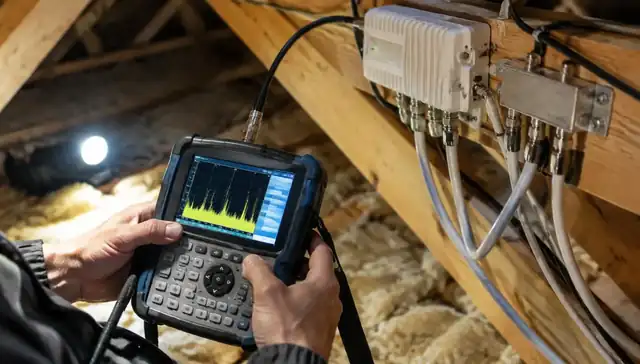
We cover NW7 detached houses, inter-war semis and Millbrook Park homes. Whether the complaint is an occasional frozen picture or several dead sockets, our job is to narrow it down before recommending expenditure. A high reading on the television's strength bar does not settle the question.
Separate the hillside from the house wiring
Around Mill Hill Village, favourable roof height can disguise losses further along the cable. On lower roads, an installation may already be working close to its reception limit. We measure both possibilities. Simply fitting a larger aerial misses the point if clean reception enters the loft and deteriorates after a distribution unit.
We consider obstructions from the actual aerial position, including neighbouring roofs and vegetation towards Arrandene Open Space. Ground-level views are not enough to choose a remedy. Where access permits, comparisons at the receiving equipment help establish whether positioning, alignment or the indoor network deserves attention first. We explain any untested areas.
A useful fault record takes less than a minute
Write down the programme, room and time when breakup occurs. Include whether it is windy, wet or completely calm. If another television still works, note that too. These observations help distinguish a marginal incoming signal from a branch fault or interference that appears only when particular equipment is operating.
Tell us about building changes: a loft conversion, roof insulation or a new television point can alter the original arrangement. At Millbrook Park, we also ask whether the feed is private or managed with the building. Please do not remove socket plates or adjust rooftop fittings to gather information; an ordinary photograph is enough for booking.
Quality readings reveal what strength bars leave out
Digital programmes arrive in multiplexes, so several apparently unrelated channels can fail together. We compare those groups using a signal meter rather than relying on the television's percentage display. MER describes modulation quality, while BER shows data errors at the meter's supported correction stages. We interpret them alongside signal level.
A strong but distorted feed needs a different solution from a clean signal weakened by a long cable. We look at the available margin as well as today's picture. Where readings change substantially between test points, we investigate the intervening components. We can then explain why a suggested repair is relevant to your symptoms.
Larger houses can hide a distribution problem
A detached home with televisions on several floors may have a powered distribution amplifier, more than one splitter and cable runs added at different times. We establish the layout before making changes. The useful comparison is between the incoming supply and each agreed branch, not between whichever televisions happen to be easiest to reach.
We inspect accessible connectors, power arrangements and wall outlets, then check the short leads serving receivers. Unused branches and incorrectly connected power injectors can complicate the system. We explain what each component is doing before proposing simplification. Testing stops at inaccessible sections unless you authorise a suitable way to reach or bypass them.
Amplification is a calculation, not a cure-all
A wooded valley position may need careful aerial selection, but adding gain without measuring can make matters worse. We check whether an existing amplifier has adequate input quality and whether its output overloads the next stage. We also verify its power supply before treating a complete loss of reception as an aerial failure.
If unwanted mobile signals appear relevant, we examine the spectrum and test a suitable filter ahead of the affected equipment. We do not fit filters solely because a mast is visible nearby. For brief bursts linked to household activity, we can compare readings while you operate accessible lights or appliances to help identify the pattern.
Investigating mobile signal interference →Nearby Edgware fault finding →
When weather exposes a physical defect
Cable jackets, outdoor joints and mountings are part of the diagnosis. Wind-related failure might follow movement in a loose connection, while rain can expose failed weather protection. We inspect the installation's condition alongside the meter results. Neither a green-looking connector nor a swaying branch proves the cause without further checks.
Safe access determines what can be confirmed on the day. Tell us about extensions beneath the aerial, locked side gates and loft hatches before the appointment. We discuss any specialist access requirement separately. If an intermittent fault remains absent, we record what the visit establishes and agree a sensible next test instead of claiming certainty.
Shared feeds and dish receivers are checked differently
In a managed building, we identify the system owner before working beyond the flat. A failed communal output can affect one home while neighbours remain unaffected. Access to the distribution cupboard, permission from the agent and the correct socket identification make the investigation more useful than changing the resident's television repeatedly.
For a satellite receiver, we establish the required feed type and check the relevant cables, connections and LNB supply. We compare available feeds where the equipment permits. Terrestrial reception measurements cannot diagnose dish alignment, and an internet-only viewing problem should not lead to an aerial replacement. We keep those routes separate throughout the visit.
Mill Hill shared aerial systems →Satellite equipment in NW7 →
A decision you can make with the findings in front of you
We describe the fault we have established, distinguish any remaining uncertainty and supply a fixed written quote for recommended repairs. After approved work, we remeasure the affected route and demonstrate reception. Our aim is to leave you understanding what changed, rather than wondering which replacement happened to make the picture return.
Reach Finchley Aerials and Satellites on freephone 0800 206 2385; WhatsApp is 07595 292534. We have 25 years' experience and are based at Britannia Road, Finchley N12 9RU. Free advice is available Mon-Sat, 8am-7pm. Same-day visits depend on availability, and outdoor site work finishes by sunset.