
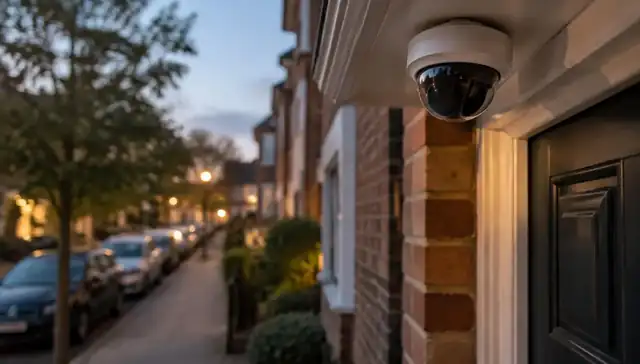
We also take on systems supplied by other installers. Across NW7, from detached houses near Mill Hill Village to inter-war semis and Millbrook Park homes, we investigate missing pictures, unreliable recordings and inaccessible apps. Keeping serviceable equipment is part of the assessment, not an afterthought.
Walk the boundary before choosing the cameras
At the survey we ask where you park, which gate deliveries use and whether anyone approaches through a side passage. Larger plots can have several separate access points. One broad view of the garden will not necessarily show someone at a rear door, especially when planting divides the scene.
We sketch the useful views and check their mounting positions, power and cable access. Around Arrandene Open Space, trees and shrubs deserve attention both as obstructions and as moving objects that can trigger alerts. We assess your own boundary rather than assuming the camera should look towards the open space.
Find out why the existing picture has failed
If one channel goes black, we check its supply, connector and cable before condemning the camera. Several lost channels may point to a shared supply or recorder problem. We compare working and failed parts where compatible, building up evidence instead of fitting replacements in the hope that something changes.
Outside connections need inspecting when failures follow wet weather. We look for water entering junctions, cracked cable jackets and unsecured runs. Tell us if the recorder contains footage you need: we avoid initialising storage or performing destructive resets without discussing the consequences. A repair visit can address another firm's installation without requiring a wholesale replacement.
Driveway detail needs the right distance and angle
For a deep driveway, we distinguish between seeing that somebody arrived and recognising them at the entrance. A high camera taking in the entire frontage can leave faces too small. We may suggest a tighter doorway view alongside an overview, explaining the purpose of each rather than simply adding more cameras.
Vehicle headlights, gates and parked cars can all change the picture. We consider their likely positions when selecting the lens and height. Number plate capture is a separate requirement with its own lighting and angle constraints; we do not promise readable plates merely because a camera specification says 4K.
Choose cable routes that can be maintained
In an inter-war semi, a loft route may help us reach the front and side without crossing decorated rooms. Extensions can interrupt that path, so we inspect rather than assume. At Millbrook Park, we establish wall construction and any restrictions on external alterations before agreeing brackets or drilling positions.
Wired network cameras can receive power and video through a suitable Ethernet connection. We protect outdoor terminations, support exposed cable and seal the building entry. An older coaxial installation may still be usable with compatible equipment. We test its condition and format before offering a staged upgrade or an entirely new cable layout.
Plan for the darker end of the garden
A bright road near Mill Hill Broadway does not tell us how much light reaches a rear gate. We examine the scene at the camera position and discuss what changes after sunset. Colour images require sufficient illumination; infrared offers a different result and can reflect off nearby walls or foliage.
We avoid directing camera lights into adjoining bedrooms. Where insects, cobwebs or vegetation cause a white haze, cleaning and repositioning may be more useful than replacing the entire unit. We explain what can be assessed during daylight and whether an evening image supplied by you would help confirm the adjustment.
Prove that a recording can be retrieved
Live video alone does not demonstrate working storage. We check the recorder date, drive status and recording timetable, then find a saved event. Storage duration depends on capacity, image settings and activity. We agree a sensible arrangement rather than assigning every system the same retention period.
For phone viewing we test outside your home network, using mobile data. We show you playback and clip export, review account permissions and help remove unnecessary access where supported. Local recording can continue without broadband when the system is configured for it and remains powered; viewing from elsewhere will still need an internet connection.
Keep the view proportionate to your property
We narrow camera coverage to the entrances you want to protect and use privacy masks where available. Capturing neighbouring gardens or public space can bring data protection obligations. We talk through limiting the view, signs, access to recordings and deletion, while making clear that technical advice is not legal advice.
Shared drives and managed developments need an identified decision-maker. We ask who owns the mounting surface and who will control recorded images. Near Mill Hill Village, any applicable listed-building or conservation restrictions need checking before work. We normally avoid audio recording unless there is a specific, properly considered reason for it.
Arrange advice without buying a replacement kit first
Ring 0800 206 2385 free or send a WhatsApp to 07595 292534. A recorder model and description of the fault help us prepare; keep passwords out of messages. We offer free advice, a free site survey and a fixed written quote, with chargeable repairs agreed separately.
We are Finchley Aerials and Satellites on Britannia Road, Finchley N12 9RU, bringing 25 years' experience. Our hours are Mon-Sat, 8am-7pm; on-site work continues until sunset. Same-day attendance is possible when the diary and access allow. We explain the proposed work and its price before you authorise it.