
Finchley usually has useful Crystal Palace reception, but that does not make every N3 roof or socket equally reliable. Blocks along Ballards Lane, trees and the position of a lower roof all deserve consideration. We check the building in front of us, not an assumption about the whole neighbourhood.
The television is our first comparison point
We check which input is selected and how the programme reaches the screen. Freeview uses the aerial feed; a streaming app uses your internet connection. If the apps work while broadcast channels break up, that distinction saves an irrelevant router reset. Tell us whether a separate recorder or receiver sits between the aerial socket and television.
Next we compare the socket feed, connecting lead and receiver behaviour. A plug strained behind a newly moved cabinet can mimic a larger installation failure. We check accessible connections carefully and use a test lead where useful. Working through these small possibilities first can prevent unnecessary work on the roof.
One good channel does not clear the whole feed
Broadcast programmes travel in frequency groups. Damage or interference can affect one group more severely than another, leaving a mixture of clear and missing services. We measure across the relevant multiplexes instead of using a single channel as a pass or fail test. HD receiver compatibility is another separate check.
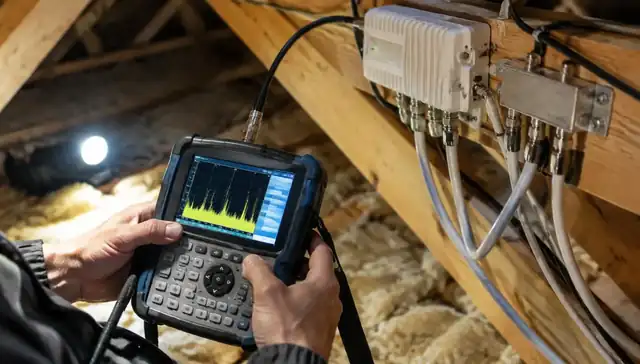
Our meter records signal level, MER and BER. In plain terms, we need both enough signal and data that arrives cleanly. A high strength bar can coexist with errors that stop the picture decoding. We explain which readings change between the incoming feed and your room outlet, rather than giving you an unexplained number.
What fault finding includes →Transmitter and channel guidance →
N3 houses often have more than one cable history
Edwardian semis around Regents Park Road and inter-war houses can have original room feeds alongside later additions. We look for hidden splitting, abandoned branches and joints disturbed during building work. A neat wall plate does not prove the cable behind it is correctly terminated or suitably screened.
A typical job here: the front room remains clear after a rear extension gains a television, but both upstairs sets become unreliable. We trace how the extra outlet joins the distribution and compare the branches. That tells us whether the additional loss, a poor joint or an amplifier setting explains the change. We do not simply add another booster.
Repairs to existing Finchley aerial systems →Local property coverage →
Separate roof-position problems from indoor losses
Near Victoria Park, foliage can be relevant to a marginal path, but trees are not a diagnosis by themselves. We consider aerial height, physical condition and measured quality alongside any nearby obstruction. Where moving the aerial is justified, we assess the proposed location before recommending an installation change.
We also inspect accessible external coax and weather protection. Rain-related failure can come from a damaged cable even when the aerial remains secure. Safe roof access must be established before close inspection. If a chimney or high mounting requires additional equipment, we make that part of the plan rather than improvising access on arrival.
More gain is not always better reception
We test the amplifier supply and compare its input with its output. Increasing level can help compensate for measured distribution losses, but it cannot restore corrupted data. Too much gain may overload equipment. We check whether existing amplification serves a purpose and whether its settings suit the number of connected outlets.
Suspected mobile interference needs evidence too. Spectrum measurements and a controlled filter comparison help us decide whether unwanted signals are entering the system. We consider filter position relative to the affected amplifier. For interference that follows a lamp or power adaptor, we investigate that timing rather than assuming all disturbance comes from outside.
Purpose-built flats need a clear responsibility boundary
In a Ballards Lane flat, we establish whether your socket receives a communal feed and ask if other residents are affected. The fault may lie before the signal enters your home. We can test the accessible outlet within the agreed visit, but communal cupboards and roof equipment require the appropriate authority and keys.
Please tell the managing agent what is happening and share any existing system information with us. We avoid adjusting equipment that could interrupt neighbours. If the shared feed tests correctly, we continue with your private lead and receiver. If it does not, our findings help define the next authorised investigation.
Know what we found and what you are approving
We separate the investigation from any proposed repair, explain visit charges when arranging attendance and give a clear price before work starts. After an agreed repair, we check the affected outlets again and demonstrate the restored channels. If an intermittent fault remains unconfirmed, we explain the uncertainty and agree useful monitoring rather than inventing certainty.
Our base is Britannia Road, Finchley N12 9RU. Finchley Aerials and Satellites has 25 years' experience, with free advice on 0800 206 2385 or WhatsApp 07595 292534. Contact hours are 8am-7pm, Monday to Saturday. We aim for same-day visits when possible and schedule exterior work within daylight, finishing by sunset.