
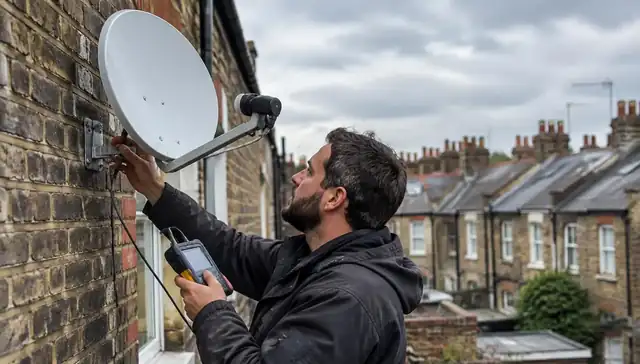
For an Edwardian semi near Victoria Park, the priority might be keeping cable away from decorative brickwork. In a flat off Ballards Lane, it may be identifying the shared feed before anyone orders a private dish. We start with what your property and equipment actually need, then set out the work clearly.
Keeping a good dish when the box changes
An old Sky dish may still be perfectly serviceable for a move to Freesat. We examine its condition and alignment, then identify the LNB and receiver requirements. Different Freesat generations do not all use the same arrangement, so we ask for the exact model rather than making assumptions from the brand.
Sky Q commonly needs wideband feeds, while older receivers can require universal outputs. If both types are staying, we consider a compatible mixed arrangement. We explain which parts can remain and which must change. Your subscription or account stays between you and the provider; we independently handle the receiving hardware and installation.
Ballards Lane flats: find out what the socket serves
A plate labelled SAT does not tell us everything about the system behind it. In purpose-built blocks around Ballards Lane, the connection may run through communal distribution equipment. We check the feed and establish who owns the roof equipment before suggesting alterations. The building manager may need to provide cupboard or roof access.
If only your flat has lost reception, the fault may be at its outlet or individual feed rather than the shared dish. If neighbours report the same symptoms, that changes the investigation. We keep work inside your home separate from changes to communal infrastructure and obtain the necessary authorisation for shared components.
A wall position can be better than a chimney
We look for a clear path towards the satellites used by your chosen service, normally 28.2 degrees east for UK Sky and Freesat. Around Regents Park Road, nearby blocks or mature planting can limit a low position. We assess the actual direction on site instead of judging from the apparent openness of the garden.
Where a sound wall provides the required view, it can make future maintenance simpler than a high roof position. We consider bracket support, cable distance and appearance together. Permission checks still apply, particularly for rented homes or protected buildings. We do not treat a hidden position as automatically suitable or automatically exempt from consent.
Resolve the reason a picture keeps breaking up
A dish does not usually need replacing simply because rain coincides with a failed picture. We inspect alignment, the receiving unit, exposed joints and the coax entering the house. A marginally aligned dish or moisture in a connector can make relatively ordinary weather reveal an underlying defect.
We measure reception quality at useful points in the installation and compare results. Movement at the support needs correcting before final adjustment; otherwise the next windy day can undo the work. We describe the faulty element and propose a proportionate repair, retaining working parts wherever their condition and compatibility make that sensible.
Investigate a reception fault →Satellite work in North Finchley →
Cable details matter in a finished N3 home
Before making holes, we agree the outdoor route, entry point and final receiver position. An inter-war house may have an accessible side wall; an Edwardian semi may need a more careful route around original features. We explain what will remain visible and avoid promising concealed wiring without checking the building.
Suitable screened coax is supported at sensible intervals, kept clear of damaging edges and terminated neatly. Exterior connections need protection from water, and the wall penetration is sealed. If an existing run can be reused, we test it first. We also label or explain multiple feeds so a future furniture move does not become a guessing exercise.
Plan dish moves before the builders arrive
A loft conversion, rear extension or scaffold tower can block a dish that worked yesterday. Tell us about the proposed work before it starts if possible. We review the future signal path and discuss whether relocation is temporary or permanent, including how the cable will reach the existing receiver.
We need safe access to any agreed location and permission to use the fixing surface. Moving the dish sideways without checking its view can exchange one obstruction for another. After relocation, we realign with test equipment and verify the indoor feeds rather than relying on the fact that the box has found a single channel.
Check viewing, recording and the spare feed
At completion we confirm that the specified feeds are working and connected correctly. Where your receiver supports recording, we check the relevant operation as well as live viewing. Testing across appropriate transponders helps expose problems that a quick glance at one programme could miss.
We show you what has changed outside and behind the television. Satellite reception and internet applications are separate connections, so a working dish does not repair a broadband problem. We explain that distinction if your box uses both. Any limits caused by the building or retained equipment are discussed openly rather than hidden in the handover.
Talk to our Finchley-based team
Our base is Britannia Road, Finchley N12 9RU, and we bring 25 years' experience to local receiving systems. Ring 0800 206 2385 free for advice, or WhatsApp 07595 292534 with a postcode and receiver label. Please take photographs from ground level only; there is no need to climb to identify a dish.
We answer Mon-Sat between 8am and 7pm and undertake on-site work until sunset, subject to safe conditions. Same-day service is possible when availability allows. Before installation begins, we agree the specification and provide a fixed written quote, including any access requirements that affect the proposed work.