
N2 includes sloping ground below Highgate Wood, older terraces and flats beside the High Road. Those settings need different checks. We separate an awkward roof position from a defective cable or distribution unit, then explain the evidence before recommending work. You do not have to diagnose the problem before calling us.
What changed before the picture disappeared?
Start with the sequence: did channels disappear after moving furniture, fitting a new receiver or having building work done? We ask whether every television suffers and whether recordings fail too. A damaged flylead behind a cabinet can look much like a roof fault until we compare the feeds.
If the trouble comes and goes, note the channel, approximate time and weather. Leave the tuning alone during a reception outage; searching again can remove channels that would return when the signal recovers. We can use a photograph of the on-screen warning, but please avoid moving equipment that is difficult to reach.
Measure quality, not just the size of the signal
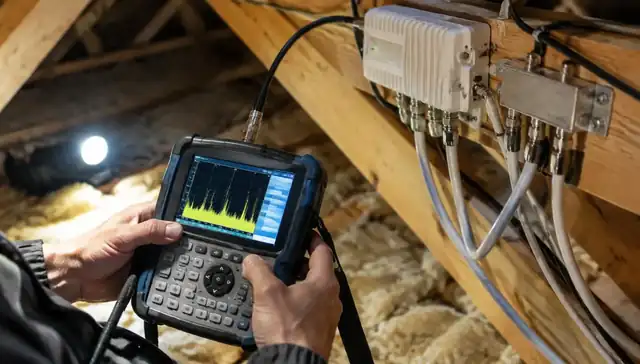
Our meter checks level alongside modulation error ratio and bit error rate. These readings help establish whether the received data is clean enough for reliable decoding. A large signal can still contain errors, while an overloaded amplifier may make the television's strength display look reassuringly full.
We examine the separate broadcast groups, known as multiplexes. Losing several channels together can point to a frequency-specific problem rather than several unrelated failures. Comparing those groups at the wall outlet and further upstream shows where quality deteriorates, so we are not relying on the television's own percentage display.
Our diagnostic service →Crystal Palace reception explained →
The slope matters, but it is not a diagnosis
Below Highgate Wood, the ground and surrounding buildings can restrict the useful signal reaching an aerial. We assess the actual mounting position rather than assuming every home near Cherry Tree Wood needs more height. Roof obstructions, the direction of reception and the condition of the existing installation all enter the assessment.
A taller mast brings access and mounting considerations as well as possible reception benefits. We first establish whether the feed is already satisfactory before it enters the house. Where an alternative transmitter is worth investigating, we explain any difference in channel availability rather than treating every available signal as interchangeable.
Tracing branches through a terrace or conversion
Victorian and Edwardian houses can have television cables added at different times. We identify the incoming feed, powered equipment and room branches before disturbing connections. A redundant splitter hidden behind furniture may reduce the available level, but we test it before deciding that it needs removal.
A typical job here: the front room receives every service while an upstairs television loses one channel group. We compare both outlets, substitute a known working flylead and test the affected branch. If deterioration begins at a wall plate, the repair can stay local instead of becoming an unnecessary aerial replacement.
High Road flats: establish who controls the feed
In a modern block near the Phoenix Cinema or East Finchley station, your socket may connect to a communal installation. We can check the accessible outlet and receiver within your flat, but shared risers and headend cupboards need authorised access. Tell us who manages the building when arranging the appointment.
If neighbours report the same missing services, that is useful evidence, not permission to alter communal equipment. We agree the diagnostic boundary and identify any further access required. This prevents a private flat visit being mistaken for authority to disconnect or adjust a system serving other residents.
Rain, electrical noise and mobile signals
Weather-linked breakup prompts inspection of outdoor joints, exposed cable and mountings wherever access is safe. We look for cracked insulation and moisture paths. If reception fails when a light or appliance switches on, we compare that timing with meter readings rather than putting every intermittent problem down to the aerial.
Mobile interference needs supporting measurements too. We examine the spectrum and assess whether filtering improves reception before recommending a filter. Its position matters: protection after an amplifier that is already overloaded may not solve the underlying issue. We also check screening and connector condition along the affected path.
Agree the remedy and verify the result
We distinguish confirmed defects from suspected causes. If an intermittent fault stays absent throughout testing, we explain what the readings do establish and agree further observation if necessary. For satellite reception, the investigation instead follows the dish feed, LNB supply and receiver connections; aerial tests cannot substitute for those checks.
Once the cause is established, you receive a fixed written quote for the proposed repair. We keep serviceable components and repeat relevant measurements afterwards. Where roof work needs different access equipment, that is discussed separately rather than attempted from an unsuitable ladder position or without the necessary permissions.
Book an N2 diagnostic visit
Call free on 0800 206 2385 or send your postcode and symptoms by WhatsApp to 07595 292534. We offer free advice and same-day attendance where possible. Our hours are Mon-Sat, 8am-7pm, with outside work continuing only until sunset and when conditions permit.
We are Finchley Aerials and Satellites, Britannia Road, Finchley N12 9RU, with 25 years' experience. Mention the number of televisions and any shared-system arrangements when booking. We explain the visit scope and provide a clear price before work starts, so the next step is understood.