
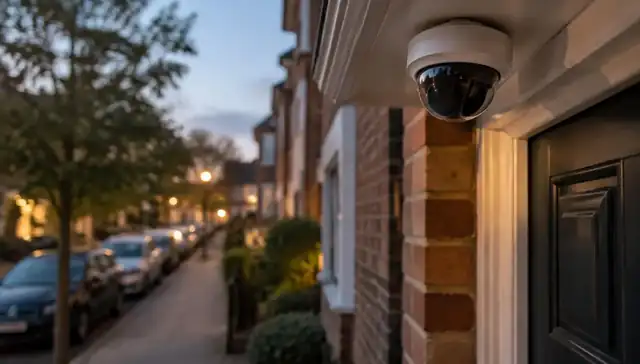
If cameras are already there but no longer reliable, we can investigate them regardless of who fitted them. Keeping a discreet, serviceable installation may be preferable to running fresh cables across the house. We establish what is working, what needs attention and what any proposed changes would involve.
Define the purpose before choosing a position
Do you need to see callers at the porch, movement along the side path or access through a garden gate? Each is a different task. At Arts & Crafts cottages and larger houses, projecting porches and planted boundaries can hide an approach from a single high camera.
We walk those approaches with you and explain the difference between watching an area and recognising someone within it. Around Central Square, as elsewhere in NW11, we assess the individual plot rather than assume neighbouring houses need identical equipment. A smaller, well-aimed system can be more useful than several overlapping wide views.
Allow for Trust requirements before arranging installation
We discuss external housings, brackets and visible cable routes early. Suburb Trust controls and any other relevant permissions need checking for the actual proposal; we do not treat a replacement camera as automatically exempt. You should establish the required approval before we make alterations.
Our survey can identify proposed fixing points and describe the route for your permission enquiry. We consider less prominent elevations where they still give a useful view, while avoiding damage to decorative features. Concealing a camera behind foliage is not a reliable compromise if it blocks the lens or reflects infrared light.
Free survey, then a defined written scope
There is no charge for our site survey. Alongside the views, we assess safe access, cable entry, power and the recorder location. We ask about existing equipment and whether you need to retain recordings. That prevents a new specification from ignoring useful parts you already own.
The quote states the work we recommend and gives you a clear price before work starts. Repairs and extended diagnostic work are separate from the free survey, with their costs agreed beforehand. If consent or access remains unresolved, we explain what must happen before fitting can be booked.
Repair quiet failures as well as obvious blank screens
A live picture does not prove that footage is being saved. We check the recording schedule, storage status, clock and playback when investigating an existing system. A beeping recorder or missing event may point to a storage issue, but we test before recommending a drive or recorder replacement.
For cameras that cut out, we inspect power, cable terminations and weather protection. Another firm's installation is welcome: we identify the equipment and check compatible options. Older coaxial runs can sometimes remain in use, provided their condition and the camera format suit the proposed repair. We explain limitations rather than promise universal compatibility.
Wooded surroundings need a realistic night assessment
Near Big Wood, a garden approach can be sheltered from the light available on the road. We examine illumination where a person will stand, not just at the mounting point. Colour night performance depends on adequate light, while infrared produces a different kind of image in darkness.
Branches close to the camera can trigger alerts and wash the picture with reflected infrared. We account for their position when setting the view and supported detection zones. If supplementary lighting would improve the result, we discuss brightness, direction and neighbouring windows. Equipment should not solve your dark path by lighting somebody else's bedroom.
Give cables a planned route and the recorder breathing space
We generally use wired cameras for a permanent system, with network cabling carrying power and video. This avoids battery charging and dependence on wireless coverage through the house. We agree clipping, entry points and internal runs before starting, rather than leaving loose cable along garden fences or across doorways.
The recorder should be accessible for maintenance without being left in an obvious public position. It also needs ventilation. We check its connection to the router and discuss how footage will be stored locally. If existing routes pass through finished rooms, we explain what can be reused and where a new route is necessary.
Set limits on capture and access
Gardens and neighbouring windows should not become incidental monitoring targets. We aim at your entrances and use supported privacy masks to exclude unnecessary areas. Recording beyond your boundary can bring data protection duties, including considering signage, retention and how requests for footage are handled.
We normally keep audio disabled. At handover, we show authorised users live viewing, saved footage and clip export, then test remote access using a mobile connection. You retain control of the main account. Storage capacity and recording settings determine retention, so we explain the chosen arrangement rather than guarantee an unchecked number of days.
Get advice before buying replacement equipment
Tell us your address, the problem and the recorder make when you call 0800 206 2385, free to call. We answer Monday-Saturday, 8am-7pm. You can also WhatsApp 07595 292534 with equipment photographs; keep account credentials out of those messages.
Our business is Finchley Aerials and Satellites, Britannia Road, Finchley N12 9RU, with 25 years' experience. We offer free advice, same-day visits when possible and on-site work until sunset. Whether you need a repair or a new system, we can begin with a discussion rather than a commitment to replace everything.