
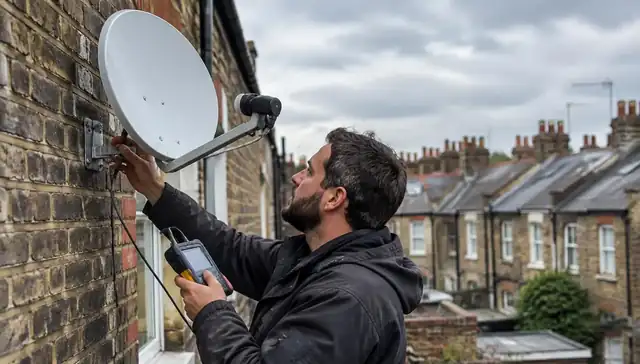
Below Highgate Hill, Victorian conversions and post-war blocks present different access problems. We establish whether your feed is private or communal, then agree the work and a clear price before starting. Our advice is free, and same-day appointments are possible when access and the diary allow.
Start with what the receiver is telling you
Tell us whether the message appears on every channel, whether recordings fail and whether the trouble follows wind or rain. We ask for the box model rather than just the Sky or Freesat name. A photograph of the rear connections can help identify the arrangement without you disconnecting anything. We check the receiver settings and accessible leads before arranging exterior repairs. A satellite input and a television aerial socket do different jobs; plugging into whichever outlet fits can leave a perfectly good receiver without the feed it needs.
A dish position behind the terraces
Near Whittington Park, extensions and neighbouring rooflines can close the view from a rear wall. We assess the actual path towards the satellites around 28.2 degrees east, not the direction of a terrestrial television transmitter. The shadow below Highgate Hill does not automatically mean your dish needs a taller support. We compare usable mounting locations, allowing for trees and safe maintenance access. If a low rear position works, we explain that option before proposing a conspicuous roof installation. Brick walls cannot be hidden in the signal path.
Loose brackets come before fine alignment
When pictures disappear in gusts, we inspect the dish support and fixing surface before touching the alignment bolts. A flexible bracket or failing masonry can make a good meter reading temporary. We check the reflector, arm and receiving head, called the LNB, for damage. Corroded components are assessed individually rather than used as a reason to replace everything. After securing the mounting, we adjust direction, elevation and LNB rotation, then compare quality on suitable transponders. That gives us a better picture than one briefly working entertainment channel.
New Sky and Freesat connections in conversions
An upstairs flat may have inherited coax that actually belongs to another dwelling. We identify your cable at both ends before connecting new equipment. Sky Q normally uses a different LNB arrangement from older Sky boxes, while Freesat requirements depend on receiver generation. We specify against the exact model and the functions you intend to use. If you want two different receivers retained, we check a compatible combined solution rather than assuming a passive splitter will provide independent satellite feeds. Your subscription remains a matter for the provider.
Keep water out of the cable route
A cable draped through a side return can be crushed by a door or damaged during decoration. We inspect exposed runs, connectors and wall entries, particularly when reception worsens after rain. Water can travel inside coax and affect equipment indoors, so renewing only the visible plug may leave wet cable behind. We agree a supported external route, use suitable screened satellite cable and weatherproof the connections. Inside, we leave identified feeds with enough slack for ordinary access, without loose loops across shared stairs or doorways.
Shared roofs around Archway Tower
For a post-war block, roof access and equipment ownership have to be settled before an appointment involving communal hardware. We can investigate your accessible lead and outlet first, but alterations to distribution equipment require permission from whoever manages it. Tell us whether other residents have the same failure. One affected flat suggests a different starting point from a whole building without reception. We coordinate authorised access and explain any compatibility work needed for Sky Q. We do not disconnect neighbouring services to make an individual receiver work.
Discreet work with an agreed access plan
Around Dartmouth Park, a tidy installation means thinking about frontage, shared entrances and the route through the building. Leasehold consent and any relevant planning restrictions need checking before drilling. We discuss the mounting surface and visibility with you rather than treating the shortest cable as the only consideration. Parking arrangements, locked gates and scaffolding affect the visit too. We assess safe working access in advance; a dish visible from a bedroom window is not necessarily reachable safely from that window. Additional access equipment is included in the agreed scope.
An Archway visit ends at the television
We finish by checking the required feeds indoors and demonstrating live reception and supported recording functions. We explain any weather-related limitation rather than promising that satellite television can never break up. Call Finchley Aerials free on 0800 206 2385, Monday to Saturday, 8am to 7pm, or WhatsApp 07595 292534 with your postcode and a ground-level dish photo. Our base is Britannia Road, Finchley N12 9RU, and we bring 25 years of experience. Exterior work continues only while daylight and conditions make it safe, with on-site work until sunset.